An apartment can support responsible dog ownership when the daily routine works beyond the front door. Floor area matters less than reliable outdoor access, manageable toilet trips, realistic exercise options, shared space control, and a quiet place to rest. A yard can remove some friction, but it does not replace exercise, interaction, or planning. The useful test is whether the household can repeat the routine in ordinary weeks, bad weather, illness, and other disruptions.
The same floor area can create a very different dog care routine
Can you have a dog in an apartment? Often, yes, but the answer depends less on a square foot number than on what happens every time the dog needs to go outside, move, settle, or pass through shared space. Before looking at breeds, start with whether your household is ready for a dog and whether the home can support the routine you would need to repeat. Two apartments with similar floor area can produce very different workloads when one opens to a quiet ground floor exit and the other requires a hallway, elevator, lobby, and a longer walk to an appropriate outdoor area.
The practical question is whether normal daily dog care fits the building, neighborhood, household schedule, and individual dog you eventually choose. A compact home with easy outdoor access may be more workable than a larger unit with difficult exits, crowded shared areas, or no realistic place for exercise nearby. Noise sensitivity, age, mobility, activity level, and comfort around people or dogs can change the answer even when the apartment itself stays the same. Treat the home as an access system, then judge whether that system is workable before you commit.
Start with outdoor access, not indoor floor area
Indoor space tells you where a dog can rest and move around the home, but it does not show how easily basic care happens outside it. Walk the actual route from the unit to the nearest suitable outdoor area and notice every door, stair, elevator, lobby, gate, sidewalk, and traffic crossing involved. Think about whether that route still works when the dog is excited, tired, older, temporarily less mobile, or uncomfortable around crowded spaces. The more friction the route adds, the more deliberate the routine needs to be.
- Is there a practical outdoor area the dog can reach without a difficult detour?
- Are elevators, stairs, doors, and gates dependable enough for repeated trips?
- Can you avoid unsafe traffic or crowded pinch points when necessary?
- Is there a realistic place nearby for walking, sniffing, and other daily activity?
- Can another caregiver understand and repeat the same route if you are unavailable?
This checklist is more useful than trying to find a universal apartment size because it tests the care process directly. A larger apartment does not shorten a difficult route to the street, and a smaller apartment does not automatically create a problem if the dog has a calm indoor resting area and dependable access outside. If several parts of the route already feel inconvenient before a dog is involved, assume that repetition will make those weak points more important. Solve the access problem first, then decide what type of dog could reasonably fit the setup.
Map the route for routine toilet trips
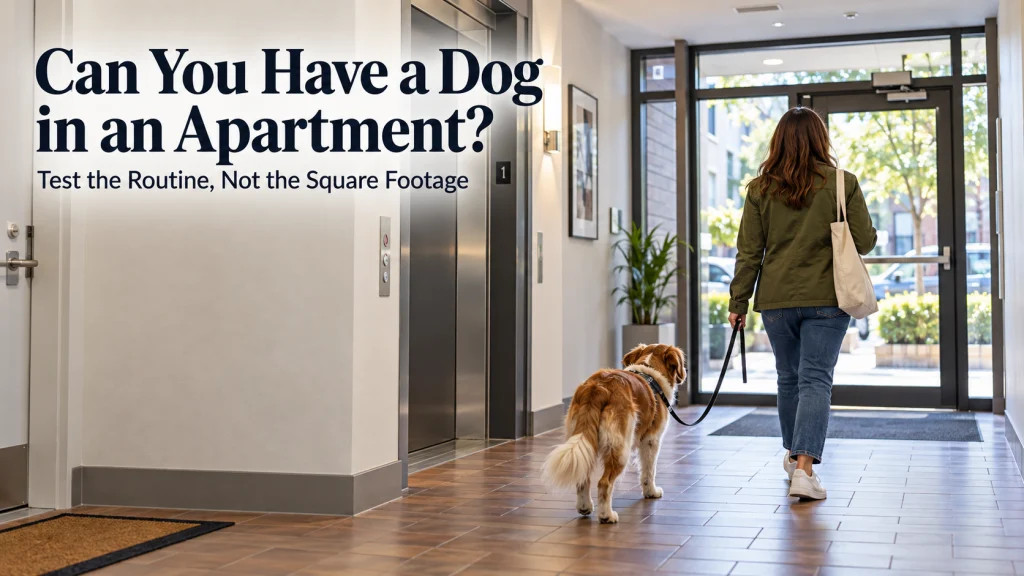
A no yard home turns every toilet trip into a small route management task. The dog may need to move from the unit through a hallway, wait for an elevator, cross a lobby, pass neighbors or other dogs, and continue to an acceptable outdoor spot. That does not make apartment living unsuitable, but it does mean the owner has to manage access instead of opening a back door. The route becomes especially important for puppies, senior dogs, dogs with limited mobility, and dogs that struggle in busy shared spaces.
| Route factor | Ground floor example | High rise example |
|---|---|---|
| Transitions | Unit door, building exit, outdoor area | Unit door, hallway, elevator, lobby, building exit, outdoor area |
| Possible delay | Door or gate access | Elevator wait, shared lobby traffic, multiple controlled doors |
| Shared space pressure | Usually concentrated near the entrance | Can occur in hallways, elevators, and lobby areas |
| Backup question | Can another exit work if the main path is blocked? | What happens if the elevator is unavailable or crowded? |
The comparison is not meant to declare one floor suitable and another unsuitable. It shows where extra transitions can create delays, close contact, and more handling work, which may matter very little for one dog and a great deal for another. Visit the route during the kinds of building conditions you commonly encounter rather than imagining the quietest possible version of it. If you cannot describe a workable toilet route and a backup route, the housing decision is not finished yet.
Treat stairs and elevators as recurring logistics, not one time inconveniences
Stairs and elevators matter because they sit between the dog and nearly every outdoor task. Stairs may be easy for a healthy adult dog yet become harder with age, injury, body shape, or temporary mobility limits, while elevators can create waiting, crowding, and close encounters. A dog that is calm in open outdoor space may still find a small elevator uncomfortable, and a physically capable dog may still need careful handling around doors and other residents. The right question is not whether the building has stairs or an elevator, but whether the route suits the dog you can realistically manage.
Look for practical alternatives before assuming you can simply adapt later. Check whether there is another elevator bank, another exit, a less crowded path, or a safe way to create more distance when another dog appears. If access depends on carrying the dog, be realistic about body size and whether every regular caregiver could do that safely if needed. A route that works only when everything goes perfectly is weaker than a route with simple options when the building is busy or part of the normal path is unavailable.
Identify where daily exercise and exploration will actually happen
An apartment does not need to contain every form of activity, but the surrounding routine must make appropriate movement and exploration practical. Identify where normal walks can happen, where the dog can sniff without constant conflict, and whether the route is realistic for the activity level you are considering. A quiet adult dog and a highly active young dog can place very different demands on the same neighborhood. That is why apartment feasibility should be tied to the individual dog’s needs rather than a simple small dog versus large dog rule.
If the nearby environment is the main activity space, review it as carefully as the apartment itself. Busy intersections, narrow sidewalks, limited shade, heavy dog traffic, or a long trip to usable green space can all increase the work needed to provide a suitable routine. The broader principles in walking and exercising a dog help separate normal daily activity planning from the housing question here. For this decision, you only need to establish that there is a repeatable, realistic place for the chosen dog’s movement and exploration needs.
Understand what a yard can make easier and what a yard does not replace
A yard can reduce friction because the owner may have a direct outdoor option for toilet trips and brief supervised access. That convenience is meaningful, especially when the alternative is a longer shared route through the building. But a yard does not automatically provide enough exercise, exploration, social contact, or engagement for every dog. It changes the logistics of outdoor access more than it changes the dog’s underlying need for appropriate daily care.
| Care question | Home with a yard | No yard home |
|---|---|---|
| Quick outdoor access | May be easier if the yard is secure and directly accessible | Usually depends on a planned route to a suitable outdoor area |
| Exercise | Still requires activity matched to the dog | Must be planned outside the unit or through suitable indoor and outdoor activity |
| Exploration | A familiar yard can become repetitive | Walk routes can provide varied smells and environments |
| Owner workload | Some outdoor tasks may involve fewer transitions | More outdoor tasks require leaving the unit and managing shared access |
The table also shows why the question “do dogs need a yard” is too blunt to decide whether a home works. Some households without yards can provide excellent routines because outdoor access and activity are easy to repeat, while some yards are treated as substitutes for walks and interaction when they should not be. Compare the actual care workload rather than the presence of grass behind a door. A yard is a convenience and management feature, not a complete care plan.
Add weather and late night access to the routine test
A route that feels easy in pleasant weather can become much more demanding in heavy rain, snow, heat, cold, or poor visibility. No yard households still need a workable way to reach an appropriate outdoor area when conditions are inconvenient. Think about shelter along the route, safe footing, lighting, building access, and whether the neighborhood path remains usable when conditions change. Climate does not automatically rule out apartment living, but it can increase the effort required to maintain the same routine.
| Stress test | Question to answer before getting a dog |
|---|---|
| Bad weather | Can you still reach a practical outdoor area without relying on an unrealistic shortcut? |
| Late night | Is the route well lit, accessible, and comfortable enough to repeat when the building is quiet? |
| Building disruption | Is there another usable route if the normal elevator, entrance, or gate is unavailable? |
| Temporary owner limitation | Who can repeat the routine if you are sick or unable to take the usual route? |
Use this as a failure test rather than a prediction of the worst possible week. If one ordinary disruption makes outdoor access nearly impossible, the routine needs another option before the home is truly ready. A workable backup might be another caregiver, another building exit, or a simpler nearby route that is still appropriate for the dog. The goal is not perfect convenience, but a routine that does not collapse as soon as conditions are less comfortable.
Make sure the dog can have a safe resting area inside
Apartment living is not only about getting outside. A dog also needs a place indoors where normal household traffic, visitors, noise, and daily movement do not prevent rest. The space does not have to be a separate room, but it should be practical for the dog’s size and positioned so the dog is not constantly in a doorway, narrow traffic path, or noisy shared wall area. Think about where food, water, rest, and normal household movement will fit before adding more gear.
This decision should stay at the layout level rather than turning into a crate or containment lesson. The broader process of setting up a home for a dog covers the details of arranging indoor zones and equipment once you know a dog is actually coming home. For apartment feasibility, confirm that the dog can settle without blocking essential household movement and that the space can stay reasonably calm and safe. If every possible resting spot is also a major traffic route, the floor plan may need changes before adoption.
Separate apartment feasibility from breed selection
Breed lists can make apartment planning look easier than it is because they jump from housing type to dog label without testing the routine in between. Size can matter, but so can age, activity level, mobility, noise sensitivity, sociability, and the needs of the individual dog. A small dog is not automatically easy in shared housing, and a larger dog is not automatically unsuitable if the household can meet its needs and manage the building route. First decide what the home can support, then use those constraints to narrow the dog search.
That sequence also helps prevent square footage from becoming a false shortcut. If the route to outdoor space is difficult, the neighborhood offers poor exercise access, or close shared encounters are unavoidable, those facts should shape the type of dog you consider. The separate guide to choosing a dog is where size, age, activity, and individual fit should be weighed more deeply. Here, the useful output is a clear list of housing constraints that the eventual dog must fit.
Check the building rules separately if the home is rented
A routine can look workable and still fail if the lease or building rules do not allow the dog you are considering. Check the actual written terms that apply to your unit rather than relying on a neighbor’s experience, an old listing, or an informal conversation. Restrictions may address whether dogs are allowed, where animals can pass through the property, or what approvals and records the building requires. Because those rules vary by property and location, this article should not treat any one restriction as universal.
Keep the housing permission question separate from the care question so neither one hides the other. A building can allow dogs while still being a poor practical fit for your routine, and a very workable apartment can still be unavailable to a dog under the governing rules. If you rent, use the dedicated guide to renting with a dog to work through the permission and lease side in more detail. Do not commit to a dog until both the rules and the daily logistics make sense.
Run the routine through a sick day and a long workday
The strongest apartment plan is one that still works when the owner has less energy or less flexibility than usual. Imagine the dog needs normal outdoor access while you are sick, busy with work, dealing with a building problem, or unable to use the usual route. Decide who can help, how that person gets access, and whether the route is simple enough for another caregiver to follow. If the entire system depends on one person always being available, the household has a fragile plan regardless of apartment size.
Work schedules deserve their own check because apartment logistics can add travel through the building before and after the time you are away. The guide to having a dog while working full time looks more closely at coverage, absences, and schedule feasibility. For the housing decision here, ask whether a caregiver can reach the dog and complete the outdoor route when your normal routine breaks. If the answer is no, build the backup system before treating the apartment as ready.
Final Thoughts: a workable apartment is an access system, not a square foot number
An apartment can be a practical home for a dog when outdoor access, toilet logistics, exercise opportunities, shared spaces, indoor rest, and building rules all work together. The decision becomes clearer when you stop asking whether the unit is big enough in the abstract and start tracing the repeated care routes the dog will actually use. A yard can simplify part of that system, but its absence is only one variable. What matters is whether the household can provide a routine matched to the individual dog.
Before choosing a dog, walk the route, inspect the shared spaces, identify realistic activity options, and test the plan against bad weather and disrupted days. Write down the constraints that remain instead of assuming training, size, or a future purchase will erase them. If the routine works only under ideal conditions, improve the setup or delay the decision. If the access system is repeatable and the eventual dog fits those conditions, apartment living can be a reasonable ownership setup.
FAQs
🏢 Can a dog be happy living in an apartment?
Yes, if the dog’s needs fit the household routine and the owner can provide reliable outdoor access, appropriate activity, rest, and management of shared spaces. Apartment size alone does not answer those questions.
🌿 Do dogs need a yard?
A yard can make some outdoor tasks easier, but it is not a substitute for activity, exploration, interaction, or care matched to the individual dog. A no yard home can work when the owner has practical access to suitable outdoor space.
📐 Is there a minimum apartment size for a dog?
There is no useful universal square foot cutoff for this decision. Evaluate the dog’s size and activity needs together with outdoor access, indoor resting space, building layout, shared areas, and the household routine.
🐕 Are small dogs always better for apartments?
No. Size can affect fit and handling, but age, activity, noise sensitivity, mobility, sociability, and individual temperament can matter just as much in shared housing.
🛗 Is a high rise apartment a problem for a dog?
Not automatically, but the route may involve more transitions, waiting, and close shared encounters. Check elevators, backup access, toilet logistics, and whether the individual dog can comfortably use that route.
🌧️ What should I test before getting a dog in a no yard home?
Walk the outdoor route, identify exercise options, check shared spaces, review building rules, and repeat the plan mentally under bad weather or a disrupted day. The setup is stronger when there is a realistic backup for outdoor access and caregiving.
References and Sources
- American Veterinary Medical Association, Selecting a pet dog: Supports evaluating home type, outdoor exercise access, work routine, housing restrictions, daily care, and the fit between the household and the individual dog.
- American Kennel Club, Moving to an apartment: Supports the practical importance of toilet routes, shared hallways and elevators, outdoor access, and close contact in apartment settings.