A full time job does not automatically rule out dog ownership, but the real test is the time nobody is available to provide care. Count commute, routine errands, after work obligations, and schedule changes alongside the workday, then decide how each uncovered window would be handled. The workable answer depends on the individual dog’s age, needs, routine, and comfort with being alone, plus the reliability and cost of any outside help. A weekly coverage map is more useful than trying to find one universal number of hours that applies to every dog.
Count the real absence window, not the job label
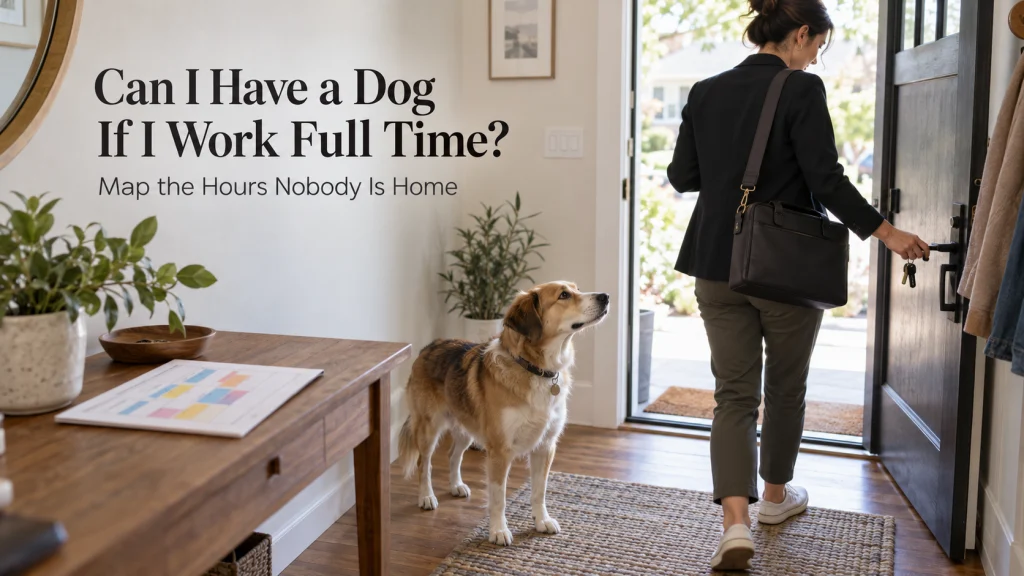
Can I have a dog if I work full time? Start by ignoring the job label and writing down when the front door actually closes and opens on a normal workday. A paid workday is only one part of the absence window because commuting, errands, appointments, social plans, and unexpected work demands can extend the period when nobody is home. That is why a schedule that sounds manageable in conversation can look very different once it is mapped across a whole week. The decision belongs inside the broader question of whether your current life can support a dog, not inside a debate over one magic number.
The next step is to separate dog ownership from wishful scheduling. If you are still working through the daily responsibilities of caring for a dog, treat every promised break, household handoff, or paid visit as a real commitment that must happen consistently. A dog still needs feeding, exercise, elimination opportunities, companionship, training, and routine care even when your calendar is busy. I would rather see a plan with modest but dependable coverage than an optimistic plan that depends on everything going right.
Map every weekday when nobody is home
Make one row for every normal weekday and record the longest stretch when no responsible person is available. Do not average the week, because an easy home day can hide a much harder office day. Record who leaves first, who returns first, whether anyone can reliably provide midday care, and whether that person has actually agreed to the responsibility. This turns a vague question about employment into a set of specific care gaps that can be solved or judged honestly.
The most useful version of this map also includes a backup for the coverage you are counting on. A partner who is sometimes home is not the same as a partner who has agreed to handle a defined part of the routine. A neighbor who may be available is not dependable coverage until the arrangement is explicit. If a row has no realistic person, service, or schedule adjustment behind it, mark it as uncovered rather than assuming you will figure it out later.
| Day | Leaves home | Returns home | Longest uncovered window | Planned coverage | Backup |
|---|---|---|---|---|---|
| Monday | Before the morning commute | After the work commute | Commute, workday, and return commute | Agreed midday visit | Second approved caregiver |
| Tuesday | Before the morning commute | After the work commute and routine errand | Commute, workday, return commute, and errand | Agreed midday visit | Second approved caregiver |
| Wednesday | No regular work departure | Owner remains home | No routine door to door absence | Planned breaks, exercise, and normal independence practice | Caregiver available if work changes |
| Thursday | Before the morning commute | After the work commute | Commute, workday, and return commute | Agreed midday visit | Second approved caregiver |
| Friday | No regular work departure | Owner remains home | Short household absences only | Planned breaks, exercise, and normal independence practice | Caregiver available if plans change |
Keep the grid practical rather than precise for its own sake. The point is to see where responsibility exists and where it does not. Once the uncovered rows are visible, you can decide whether they need routine help, a different household arrangement, or a different dog profile. That is much more useful than arguing about whether employed people in general should own dogs.
Separate predictable office days from irregular workdays
A stable office pattern and a volatile work pattern create different ownership problems even when the total workload looks similar. Predictable days let you arrange recurring care, coordinate household responsibilities, and build a routine that does not change without warning. Irregular days require more backup capacity because late meetings, shift changes, travel, or unexpected calls back to work can remove the person you expected to be available. The question is not simply how often you are away, but how reliably you can predict and cover that absence.
Hybrid work can help, but only if the home days are genuinely stable and the office days are fully planned. For example, compare an office pattern in which Monday through Friday all include a commute and a planned midday caregiver with a hybrid pattern in which Monday, Tuesday, and Thursday use that same caregiver while Wednesday and Friday are worked from home. The hybrid version reduces the number of routine paid visits, but it still needs planned exercise, normal independence practice, and a backup if a home day suddenly becomes an office day. If your employer changes attendance requirements often, build the dog plan around the less convenient version rather than the most generous current arrangement.
Add commute and after work obligations to the absence window
Commute time belongs in the dog care calculation because the dog experiences your absence from departure to return, not from the start to the end of paid work. The same is true of routine stops for groceries, exercise classes, appointments, school pickup, or social obligations. If these activities regularly happen before you return home, they are part of the normal absence pattern rather than rare exceptions. Putting them on the map prevents a work schedule from looking shorter than it really is.
This also exposes a common planning mistake: using the fastest possible commute and an empty evening calendar as the baseline. Traffic, transit delays, and ordinary life make that version fragile. I would use the usual leaving and return pattern and then ask what happens when the day is less convenient. If the answer is that nobody can step in and the dog simply waits longer, that row needs a stronger plan before acquisition.
Account for puppy, adult, and senior needs in the coverage plan
Age changes the schedule question, but it should not be reduced to a universal chart. Puppies generally need more supervision, training input, and elimination opportunities than a settled adult dog, so a work pattern with long uncovered blocks may be much harder to support at that stage. Adult dogs vary widely in activity, routine, training history, and comfort when left alone. Senior dogs may also need a plan adjusted around mobility, health, elimination, medication routines, or changing comfort, with veterinary input when health needs are involved.
That means the same household schedule can be a poor match for one dog and workable for another. If you are adopting, ask the shelter, rescue, foster home, or current caregiver what is actually known about the individual dog’s routine and behavior rather than relying on a label such as calm, independent, or low energy. If the history is limited, leave more margin in the plan instead of assuming the easiest case. A life stage can guide the questions you ask, but the individual dog should determine the final fit.
Identify which gaps require a person, a service, or a different plan
Once the weekly map shows an uncovered period, name the type of help that would actually solve it. That may be a household member with a defined responsibility, a trusted person who can visit, a dog walker, a sitter, an appropriate daycare arrangement, or a work schedule change. These options are not interchangeable because dogs differ in social comfort, handling needs, activity level, transportation tolerance, and response to group settings. The job of this article is to identify the gap, while the details of dog care when you are away belong in the care option decision itself.
A coverage option is only useful if it is available when you need it and suitable for the individual dog. A dog who is uncomfortable in a busy group environment does not suddenly have a solved schedule because daycare exists nearby. A walker does not solve a work travel problem unless someone is also responsible for the rest of the day and overnight care. Match the solution to the actual absence window rather than choosing the most convenient sounding service.
- Write down the exact care gap you are trying to cover.
- Identify the person or service responsible for that gap.
- Check whether the arrangement fits the individual dog’s handling and routine needs.
- Record a backup for cancellations, illness, travel, or work changes.
- Treat an uncovered gap as unresolved until a real plan exists.
This list is deliberately simple because the hard part is reliability, not complexity. A plan with one dependable helper and a clear backup can be stronger than a complicated network of people who have never agreed to specific duties. If the coverage depends on favors that may disappear, price and plan a more durable option before adopting. That makes the schedule test more realistic and less dependent on goodwill.
Price recurring coverage before calling it a backup
Paid help is not a backup if your normal work pattern requires it every week. It is a recurring ownership cost, and it should be tested against your budget before you commit to a dog. The relevant number is not a single advertised visit price but the amount your actual schedule would require across normal office days, busy periods, travel, and cancellations. If you have not priced that pattern locally, leave the amount blank until you have a real local quote rather than pretending the cost is zero.
This is where the schedule decision connects to broader dog ownership costs. Routine coverage can sit beside food, veterinary care, grooming, training, supplies, housing costs tied to the dog, and emergency expenses for the life of the dog. A plan that works only when paid help is treated as optional may fail as soon as the work calendar becomes demanding. I would rather delay the decision than make recurring care depend on money that is not actually available.
| Coverage need | How often it occurs | Your local quoted cost | Backup quoted cost |
|---|---|---|---|
| Routine workday visit or walk | Enter your normal frequency | Enter a verified local quote | Enter a second verified option |
| Extended workday care | Enter how often it realistically happens | Enter a verified local quote | Enter a second verified option |
| Work travel or overnight care | Enter expected frequency | Enter a verified local quote | Enter a second verified option |
Do not fill this table with national averages if those numbers do not reflect your area or the care arrangement you would actually use. Local availability, transportation, dog handling needs, and service format can change the cost substantially. The purpose of the worksheet is to require a real quote before the plan depends on paid coverage. If the quotes break the budget, that is useful information before adoption rather than a surprise afterward.
Use household schedule overlap only when responsibility is explicit
Two adults with different schedules can reduce the time nobody is home, but only if both people accept the care duties attached to that overlap. Do not count a partner, roommate, relative, or older child merely because that person is physically present. Feeding, walks, cleanup, training, supervision, and unexpected problems still require someone who knows what they are expected to do. The schedule map should name responsibility, not just occupancy, and it should make clear which duties belong to each person.
This matters especially when one person’s work pattern changes frequently. If the dog plan assumes someone else will always cover late work, travel, or commute delays, discuss those expectations before bringing a dog home. Also decide what happens when that person is sick, away, or simply unavailable, because the dog’s care cannot depend on an unspoken favor. Household overlap is a real resource when it is agreed, repeatable, and backed up, not when it exists only on the best week.
Do not assume remote work removes the care problem
Working from home can make access easier, but it does not automatically create a complete dog care routine. Meetings, deadlines, focused work, errands, and household demands can still crowd out exercise, training, play, and calm attention. A dog also benefits from learning that normal household separations are safe and routine rather than requiring constant access to one person. The goal is not to be physically beside the dog every minute, but to build a workable pattern of care and independence that still functions during a busy workday.
Remote workers should still map the week because home availability can disappear during travel, office days, conferences, schedule changes, or future job changes. If the plan collapses as soon as you are required to leave the house, it is too dependent on one work arrangement. Build a backup that can function without assuming permanent remote work, and make sure the dog can receive appropriate care when your attention is tied up at home. That makes the ownership decision more resilient to ordinary career changes.
Separate ordinary alone time from signs that need professional assessment
Planning for time alone is not the same as diagnosing a behavior problem. Some dogs rest or engage with normal activities when left, while others may show repeated distress behaviors such as persistent vocalization, pacing, salivation, destructive behavior around exits, inability to settle, or house soiling associated with the owner’s absence. Those signs can have more than one cause, so they should not be labeled from a checklist alone. If a dog shows a concerning pattern, discuss it with a veterinarian or an appropriately qualified behavior professional instead of simply extending the absence and hoping the dog adapts.
Video can be useful for showing what actually happens when nobody is home, especially when the behavior is not visible after you return. It can help you describe the sequence, intensity, and context to a professional without using the recording to diagnose the dog yourself. Medical issues, incomplete housetraining, confinement distress, outside triggers, and other behavior problems can overlap with signs owners interpret as separation anxiety. The practical boundary is simple: schedule planning belongs at owner level, but diagnosis and treatment do not.
Test the hardest normal week, not the easiest hybrid week
Before adopting, run the plan against a week that is busy but still normal for your life. Include the office days you cannot skip, the usual commute, the regular obligations that happen after work, and the times when your preferred helper is unavailable. Do not use a crisis week, because almost any plan can be overwhelmed by a true emergency. The goal is to test whether ordinary pressure exposes gaps you have been hiding with optimism.
Then run a second pass for predictable disruptions such as work travel, household schedule changes, or a temporary loss of your usual coverage. Ask whether the backup is affordable, authorized, and realistic for the individual dog. If every disruption requires a new favor or an immediate scramble, the system is fragile. A strong plan does not need to be elaborate, but it should survive common changes without leaving the dog with no appropriate care.
| Schedule pattern | What the dog plan relies on | Decision |
|---|---|---|
| Normal workweek is covered with reliable help | Agreed routine plus a practical backup | Solve the remaining setup details |
| Schedule is workable only for a dog with different needs or history | A better match between the individual dog and household routine | Change the dog profile you are considering |
| Common workdays still leave major gaps | Unreliable favors, unaffordable care, or no backup | Delay ownership until the schedule changes |
Use the table as a decision check, not as a scoring system. The middle row is not permission to choose a dog based on a stereotype about independence. It means looking for an individual dog whose known routine, age, activity, handling needs, and time alone history fit the household more realistically. If that information is uncertain, keep more margin rather than assuming the easiest outcome.
Decide whether to solve the schedule, change the dog profile, or delay
At the end of the map, there are three reasonable outcomes. You may be able to solve the schedule with dependable coverage, you may need to consider a different individual dog with needs that fit your household better, or you may need to delay ownership. None of those outcomes is a failure because the purpose of planning before getting a dog is to prevent a mismatch before a dog depends on the arrangement. A delay can be the responsible choice when the current schedule leaves recurring care gaps with no realistic solution.
If the schedule is basically workable but the dog profile needs to change, move next to choosing a dog that fits your household. Look for documented information about age, activity, handling, routine, social comfort, and known behavior rather than selecting by a breed label alone. If the schedule itself is the problem, solve that first so the search is not forced to compensate for an impossible routine. The better sequence is schedule reality first, individual fit second, and acquisition last.
Final Thoughts: the work question is really a coverage question
Working full time does not automatically make dog ownership responsible or irresponsible. What matters is whether the actual periods when nobody is home are understood, whether the individual dog’s needs fit that pattern, and whether coverage is reliable when the household cannot provide care directly. Count the full absence window, include ordinary obligations, and treat recurring help as part of the real plan rather than an emergency extra. That gives you a decision based on responsibilities instead of a slogan about employed dog owners.
Before committing, test the plan against your hardest normal week and one predictable disruption. Verify who is responsible, what paid care would cost locally, what backup exists, and what is known about the dog you are considering. If the coverage works with realistic margin, move forward to the next ownership decision. If it does not, change the schedule, change the fit you are looking for, or delay until the plan can support a dog consistently.
FAQs
🐕 Can I have a dog if I work full time?
Possibly, but the answer depends on the actual time nobody is available, the individual dog’s needs, and the reliability of your coverage plan. Map commute, normal obligations, backup care, and recurring costs before deciding.
🏠 Is working from home enough to make dog ownership easy?
No. Home availability can help, but the dog still needs exercise, training, routine care, and comfort with ordinary separation, and your plan should still work when remote work is interrupted.
🗓️ What should I put on a weekly dog coverage map?
Record each normal workday, the longest period nobody is responsible for care, the primary person or service covering it, and a realistic backup. Include commute and routine after work obligations rather than counting only paid work.
💰 Should I count a dog walker or sitter as a regular expense?
Yes, if your normal schedule depends on that help. Get local quotes for the pattern you would actually use and make sure the recurring cost fits beside the rest of your dog ownership budget.
🐾 Does choosing an independent breed solve a long workday?
No. Breed labels do not replace an individual assessment of age, activity, routine, training history, social comfort, and known behavior when alone. Choose for documented fit rather than trying to use a stereotype to patch an uncovered schedule.
🎥 When should I worry about what my dog does while I am away?
If you see a repeated pattern of significant distress, record what happens and discuss it with a veterinarian or appropriately qualified behavior professional. Do not diagnose separation anxiety from one behavior or assume that simply leaving the dog longer will fix it.
References and Sources
- American Veterinary Medical Association: Supports considering workday length, obligations after work, daily care needs, and arrangements for care during absences before getting a dog.
- American Kennel Club: Supports evaluating schedule, lifestyle, exercise, enrichment, travel, and support commitments before getting a dog.
- Merck Veterinary Manual: Supports the distinction between ordinary alone time planning and separation distress signs that require proper behavioral or veterinary assessment.