
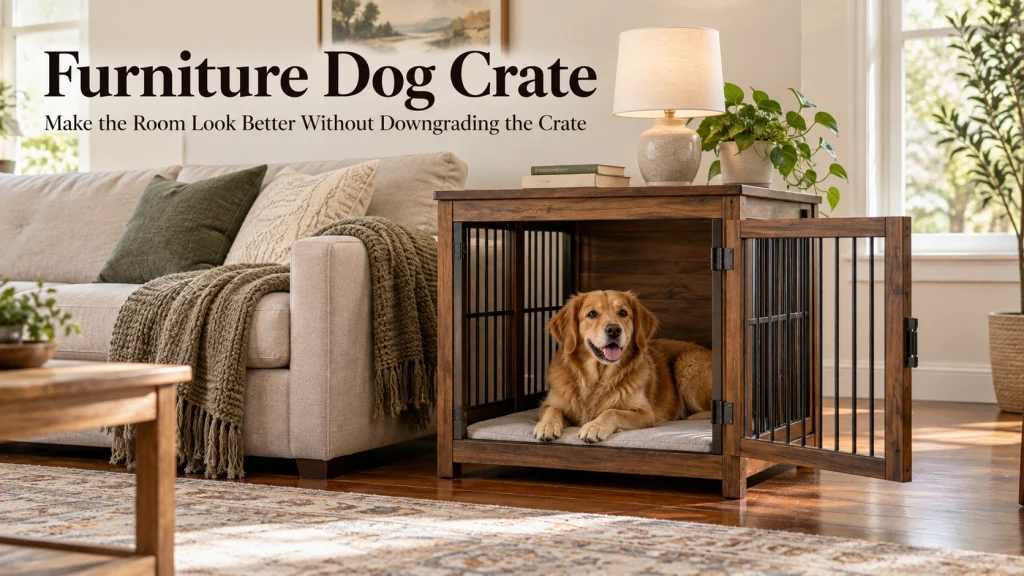
A furniture dog crate can make a living room feel more intentional, but the cabinet look should never outrank the dog’s usable space. Start with interior fit, airflow, door access, material exposure, and cleaning, then decide whether the exterior finish and usable top add real value to the room. The right choice also depends on whether your dog chews, how the crate fits the room, and what the manufacturer actually allows you to place on top. In some homes, keeping a familiar wire crate and improving how it fits the room is the simpler answer.
Look inside the crate before you judge the furniture
A furniture dog crate can look like an end table or console and still be a poor crate for the dog inside it. I would first treat it as part of your broader home setup for a dog, then compare it against the same functional questions you would ask when choosing a dog crate of any other style. The exterior can match a sofa, hide a metal frame, or recover some surface space, but none of that fixes an interior that is cramped or awkward to enter. The buying order matters because the visible cabinet is what catches your eye while the dog experiences the inside.
Start by checking whether the dog can enter without ducking or twisting, stand naturally, turn around, and settle into a normal resting position. Then look at what the room itself changes, such as a wall covering part of the ventilation, a sofa limiting the door swing, or a narrow walkway making the crate hard to access. Only after those checks would I compare finish, furniture shape, storage value, or how well the piece blends with the room. A decorative crate earns its place by doing both jobs without weakening the first one.
Inside first checklist: Before comparing finishes, confirm usable interior dimensions, a clear entrance, exposed ventilation, reachable latches, cleanable interior surfaces, chew exposure, floor protection, and the exact manufacturer’s instructions for the top surface. If any one of those checks fails, solve that problem before treating the crate as furniture. This keeps the room benefit from hiding a dog space that is harder to use or maintain. Appearance belongs at the end of the checklist, not the beginning.
Confirm the interior dimensions against the dog, not the cabinet footprint
Furniture styling can make the outside dimensions feel familiar because the product resembles a cabinet, but the dog only gets the space left inside the frame, panels, rails, and doors. Measure the dog and compare those measurements with the listed usable interior dimensions rather than assuming a large exterior means a roomy interior. A thick top, wide side panels, or decorative trim can add bulk without adding much usable space. If the manufacturer only shows overall dimensions, I would keep looking until the internal sleeping area is clear enough to evaluate.
The practical fit check is simple: the dog should be able to stand, enter, turn around, and lie down comfortably without being pressed into the door or ceiling. Bedding also occupies space, so evaluate the crate with the mat or bed you actually expect to use rather than treating the empty shell as the final setup. For a more detailed measuring process, use the dog crate size guide before comparing furniture styles. That keeps the decision anchored to the dog instead of a product label, breed suggestion, or attractive cabinet footprint.
- Record the dog’s standing and resting needs before shopping.
- Find the manufacturer’s interior length, width, and height.
- Account for any bed, mat, tray lip, or interior frame that reduces usable space.
- Check the doorway itself, not only the space beyond the doorway.
- Reject a larger looking cabinet if the actual interior still does not fit the dog comfortably.
A useful comparison is two crates with nearly identical exterior footprints where one has thick cabinet walls and the other uses a thinner structural frame. The first can occupy the same room space while giving the dog less room inside. That is why exterior measurements help with floor planning, while interior measurements answer the dog fit question. Keep those two jobs separate when you compare models.
Check ventilation on every side the room layout might block
Furniture style crates often replace open wire walls with solid panels, slats, mesh sections, or decorative openings, so the room can change how much of that ventilation remains exposed. A crate that looks well ventilated in a product photo may lose a useful opening when one side is pushed against a wall or tightly beside a sofa. Check the actual vented surfaces and imagine the crate in its final location before deciding that the airflow looks adequate. This is especially important when the design relies on openings in only one or two directions.
I would leave breathing room around the parts of the crate intended to stay open rather than treating every flat side as safe to bury against furniture. Avoid covering vents with baskets, books, blankets, or decor just because the top and sides look like normal furniture surfaces. If the room layout forces you to block the main openings, the better move may be a different door orientation, another crate design, or a different location. Decor should work around the dog’s enclosure, not quietly turn the enclosure into a closed cabinet.
Match doors and hinges to the corner or wall where the crate will live
A furniture crate can fit the floor footprint and still fail the room because the door needs more clearance than you expected. Before buying, mark the intended footprint and then check where the crate door, room door, cabinet door, sofa edge, and walking path will be when everything is open. A front door may work beside a sofa where a side door does not, while a corner placement may favor the opposite arrangement. Door direction is part of the fit, not a small convenience to think about after assembly.
The dog also needs a clean approach to the entrance instead of a narrow turn between furniture pieces. If you are still deciding which room or wall makes sense, the guide to where to put a dog crate can help separate location decisions from furniture styling. I would favor the layout that keeps the entrance easy to reach, the latch easy to inspect, and the main household walkway clear. A crate that doubles as furniture should reduce room friction, not create a daily obstacle course around the door.
| Door clearance check | What to verify in the room | Reject the setup if |
|---|---|---|
| Crate door swing | The door can open fully without hitting a sofa, wall, table, or cabinet | The dog has to squeeze through a partly opened door |
| Dog approach | There is a direct path to the entrance with enough turning room | The dog must make a tight turn between furniture pieces |
| Latch access | An adult can reach and inspect the latch without moving furniture | The latch is hidden behind decor or pressed against a wall |
| Household traffic | An open crate door does not block the main walking route | People must step around or over the open door |
Marking the crate footprint on the floor before purchase makes this check easier because you can test the door path against the actual room rather than a product photo. The goal is not to maximize empty space around the crate, but to preserve a usable entrance, a reachable latch, and a normal walking route. If those three conditions conflict, change the orientation or location before changing the dog fit. That is a room geometry problem, not a reason to accept a smaller interior.
Check whether interior wood, composite panels, or trim are reachable by a chewer
Wood and composite panels can make a crate blend into a room, but the material only helps if it suits the dog using it. Look from the dog’s position and identify exposed edges, slats, trim, corners, fasteners, and door frames that can be reached from inside. Do not assume engineered wood, decorative laminate, or a heavier looking panel is chew proof because the product appears more substantial than a wire crate. The relevant question is whether your dog’s behavior matches the material and construction the manufacturer describes.
A dog that already gnaws crate bars, door frames, baseboards, or furniture gives you useful evidence about what may happen inside a decorative enclosure. For that dog, I would prioritize a material and containment design that matches the chewing behavior rather than trying to preserve a furniture look at any cost. A calmer dog that rests reliably in a crate may give you more flexibility in surface material and finish. The crate should match the dog you have, not the tidy dog shown in the listing photo.
Look for a removable or cleanable floor before prioritizing finish
A living room crate collects the same hair, dirt, drool, crumbs, and occasional mess as any other crate, but furniture panels can make access harder. Check whether the floor or tray can be removed, whether corners are reachable with ordinary cleaning tools, and whether the surface can be wiped according to the manufacturer’s care instructions. A rich wood tone does not help much if debris gets trapped under a fixed lip or liquid can reach unfinished seams. Cleaning access should be obvious before the crate is assembled in a tight corner.
I would also think about the floor under the crate, especially if the unit is heavy enough that you will not want to move it often. Feet or a raised base can create a narrow dust zone, while a broad cabinet base can trap grit where you cannot see it. If the manufacturer specifies a removable tray, removable floor, or particular cleaning method, compare those details instead of assuming every furniture crate cleans the same way. A practical finish is one you can maintain without dismantling the room.
| Design detail | What to check | Why it matters |
|---|---|---|
| Removable tray or floor | How it comes out and whether furniture blocks removal | Makes routine cleanup more accessible |
| Fixed interior floor | Seams, corners, coating, and approved cleaning method | Shows whether mess can be reached without disassembly |
| Raised feet | Clearance for vacuuming or wiping underneath | Reduces hidden buildup around the base |
| Panel joints | Exposed gaps or unfinished edges | Helps identify places where dirt or moisture may collect |
The table is not a material ranking because the exact finish and construction still matter. Use it as a shopping inspection list, then compare the manufacturer’s care instructions with the way you actually clean the room. If a crate requires awkward disassembly for ordinary mess, that maintenance burden will remain after the novelty of the furniture look wears off. Easy cleanup is part of household fit.
Verify the manufacturer’s stated top load before using the surface as furniture
The flat top is one of the main reasons people consider dog crate furniture, but a flat surface is not automatically a rated furniture surface. Look for the manufacturer’s stated top load, use instructions, and restrictions for the exact model and size you are considering. Do not estimate capacity from panel thickness, product weight, appearance, or a staged photo showing decor on top. If the documentation does not state what the surface can support, treat that as unknown rather than filling the gap with a guess.
Also think about what daily use adds beyond simple weight, such as someone leaning on the top, a child climbing, a heavy appliance vibrating, or objects being dropped near the dog below. I would keep the surface use conservative and within the exact instructions supplied for the crate. The furniture value is useful only when it does not invite a use the crate was never documented to handle. A clear top load statement is more meaningful than the fact that the product happens to resemble a console or end table.
Key point: Check the exact model manual or manufacturer specification for the top load, interior dimensions, assembly, latch arrangement, and cleaning instructions. If a limit or use condition is not stated, do not invent one from appearance.
That verification step also protects you from transferring a specification from one size or product generation to another. Furniture crates that share a brand name can still use different panels, frames, hinges, or dimensions. Save the relevant documentation so you can refer back to it after assembly or when you change how the surface is used. Exact product information should settle exact product questions.
Decide whether improving an existing crate solves the room problem more simply
Sometimes the dog is already comfortable in a wire crate that fits well and the real complaint is simply that the crate dominates the room visually. In that case, replacing the entire enclosure with a furniture style dog crate may solve an aesthetic problem by creating new questions about material exposure, cleaning, ventilation, and door placement. Before switching, identify what you are actually trying to gain: a usable top, a warmer visual finish, less visual clutter, or a different footprint. That makes it easier to tell whether a new crate is necessary at all.
A compatible topper or other manufacturer approved way to make the existing setup integrate better with the room may preserve a crate that already works for the dog. It will not suit every household, and any added cover or surface still has to avoid blocking airflow or creating an unsupported load. The broader types of dog crates guide can help if you need to compare the tradeoffs of furniture, wire, plastic, and other designs instead of forcing one style to do every job. The simplest answer is often the one that fixes the room problem without replacing a functional dog space.
Use reinforced construction instead when containment strength is the actual requirement
A furniture look should not distract from a containment problem that the dog has already shown you. Dogs that bend wire, damage doors, break latches, chew through enclosure materials, or panic during confinement need a decision based on containment behavior, not cabinet style. A decorative crate is not automatically stronger because it is heavier, enclosed, or built with wood panels. If the problem is repeated escape behavior, the safest next step may involve both a more appropriate enclosure and qualified help with the behavior behind the escape attempts.
When you are comparing construction specifically for containment, use the heavy duty dog crate guide rather than treating furniture construction as a substitute for documented reinforcement. I would not recommend a furniture crate for panic driven escape attempts unless the exact model is documented as appropriate for that use and the dog’s behavior is being addressed at the right level. The same boundary applies to severe distress, self injury risk, or sudden behavior change, where a crate shopping decision is not the whole answer. Good room design starts with using the right type of enclosure for the job.
Final Thoughts: furniture value counts only after the crate works for the dog
A furniture dog crate is most useful when it solves a real room problem without asking the dog to accept worse fit, airflow, access, or cleanability. Check the interior first, then the door swing, ventilation, material exposure, cleaning path, and exact manufacturer limits. Once those are sound, finish and furniture utility become reasonable tiebreakers. That order keeps a decorative purchase from quietly becoming a downgrade.
I would also give extra weight to simplicity when the existing crate already fits the dog and works well in the routine. A different placement, a less visually dominant crate type, or a compatible way to integrate the current crate may solve the household problem with fewer new tradeoffs. If the dog is a strong chewer or determined escape artist, move containment strength ahead of furniture value entirely. The best looking option is the one you do not have to excuse after checking how the dog actually uses it.
FAQs
🐕 Are furniture dog crates safe for every dog?
No. Suitability depends on the dog’s size, chewing behavior, confinement behavior, and the exact crate construction. A dog that damages crates or panics during confinement may need a different enclosure and behavior support rather than a decorative crate.
📏 Should I use the outside dimensions to size a furniture crate?
No. Use the manufacturer’s interior dimensions to judge the dog’s usable space, and use exterior dimensions to judge room fit. Thick panels, trim, and framing can make those two measurements meaningfully different.
🚪 Is a side door better than a front door?
It depends on the room. Choose the door orientation that gives the dog a clear approach, lets the door open fully, and keeps the latch accessible without blocking a walkway or nearby furniture.
🧽 What makes furniture dog crate cleaning easier?
Look for a removable or easily reached floor, accessible corners, and surfaces with clear care instructions. Also check whether the crate’s final placement lets you remove a tray or clean underneath without moving half the room.
🪑 Can I use the top of a dog crate as an end table?
Only within the manufacturer’s stated use and top load for that exact model. Do not infer capacity from appearance, panel thickness, or photos showing objects on top.
References and Sources
- AKC dog crate guide: supports checking crate fit, ventilation, material differences, and cleaning considerations before style.
- PetMD crate sizing guide: supports using the dog’s measurements and usable interior space rather than relying on breed or weight labels alone.
- Preventive Vet crate measuring guide: supports measuring the dog before choosing crate dimensions and checking the manufacturer’s crate weight guidance where relevant.