
I evaluate dog gear by starting with the job the owner needs to solve, then checking fit, evidence, specifications, maintenance, failure points and value in that order. A popular product or a long feature list does not matter if the item does not suit the dog, household or routine. My goal is to separate documented facts from marketing claims and editorial judgment, then make the limits of each recommendation clear. When evidence is weak or the use case is too uncertain, the useful answer may be to make no recommendation at all.
A recommendation starts with the job, not the product
How I evaluate dog gear starts with a simple question: what real problem is the owner trying to solve? A crate, harness, feeder, bed, travel carrier or cleanup tool can look impressive on a product page and still be a poor match for the situation in front of it. I would rather define the job first, because that exposes the conditions that actually change the decision. Those conditions might include the dog’s size, body shape, age, activity, behavior context, the space available at home, the vehicle setup, the owner’s routine or the amount of cleaning and storage the item creates.
This is also why I do not treat a high review count or a familiar label as a shortcut to a recommendation. The same gear category can serve very different purposes, and an item that works for one purpose may be unnecessarily complicated for another. For general ownership decisions, I keep the broader practical dog care context in view before narrowing the choice to equipment. Once the job and constraints are clear, features become evidence to examine rather than reasons to buy.
Define the dog and household problem before opening a product page
I want the problem stated in plain language before I compare materials, capacities or extra features. “I need a better crate” is vague, while “I need a resting space that fits this dog and this room without blocking the walking path” gives me something concrete to evaluate. The same logic applies to feeding, travel, grooming and cleanup gear. If the need belongs mainly to home setup, I use the principles in setting up a home for a dog to keep the equipment decision attached to the space and routine it must serve.
A clear problem statement also reveals when buying gear is not the next step. Sometimes the owner already has an item that can be adjusted, repositioned, cleaned more effectively or used with a simpler routine. I use the following checklist to keep the decision focused on job, fit, evidence, maintenance and value rather than on feature count. If several answers are still unknown, I would pause the recommendation until those gaps are resolved.
| Question | What I check before recommending |
|---|---|
| What job must the gear do? | The actual owner task, not the product category name. |
| Who and what must it fit? | The dog, the room, the vehicle, the route, the routine and any relevant storage limit. |
| What supports the claim? | Independent guidance, a manual, specifications, a label or other evidence that matches the claim. |
| What ownership work follows? | Cleaning, setup, charging, replacement parts, consumables, inspection and storage. |
| What happens if it fails? | The likely failure point, how obvious it is and whether the consequence changes the decision. |
| Is there a simpler answer? | An existing item, a less complex design or no new purchase when that still solves the problem. |
Evaluation flow: Define the job first. Check whether the gear fits the dog, household and routine. Verify the claims that matter, then read the exact specifications and instructions. Count maintenance and likely failure points, compare a simpler answer, and recommend only when the remaining evidence supports the use case.
The flow is deliberately sequential because a weak answer early in the process can make later feature comparisons irrelevant. If the job is unclear, I do not move on to product comparison; if fit fails, extra features do not rescue the choice; if a meaningful claim cannot be supported, I narrow or stop the recommendation. Maintenance, failure risk and value come after those checks because they only matter once the item has a plausible job and fit. The checklist is intentionally ordinary because ordinary constraints are where many purchases succeed or fail.
A useful evaluation should still make sense when the product page is closed and the owner is looking at the dog and the actual space where the gear will be used. That keeps the recommendation tied to a practical decision instead of to a sales presentation. It also makes the later evidence checks much easier to interpret, because each claim has a clear place in the decision instead of competing with every other feature at once. If the sequence breaks at any point, I would rather explain the unresolved gap than force a verdict.
Fit comes before features
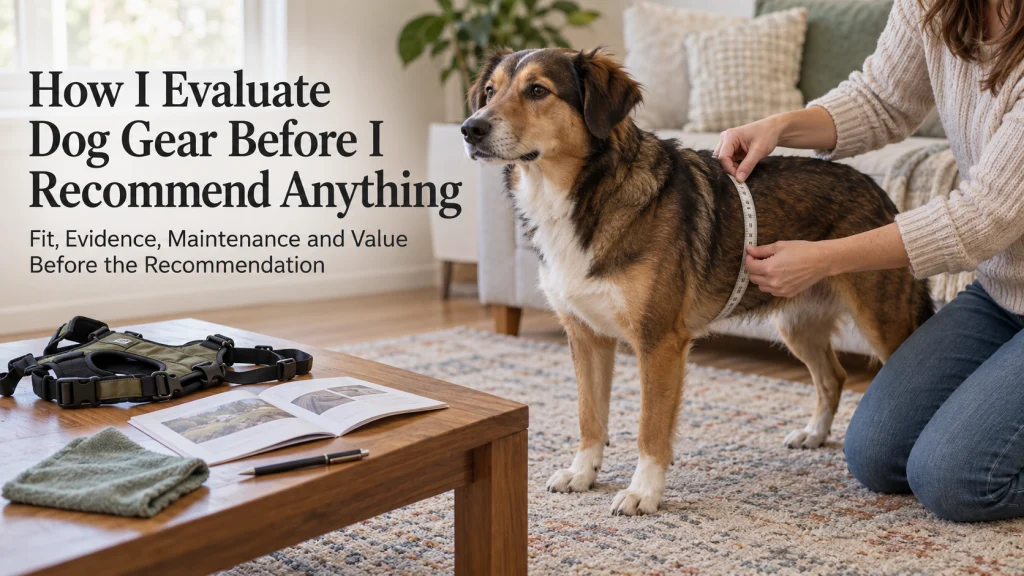
Fit is not a decorative detail added after I decide that a product looks good. For wearable gear, the same size label can represent different measurement ranges across brands or designs, so I compare the dog’s actual measurements with the chart for the exact item. For crates, beds, carriers and home equipment, I also check the space around the dog and the space available in the household or vehicle. My separate guide to dog gear sizing explains why the measurement process has to come before confidence in a size name.
Fit can also mean more than body measurements. A carrier may fit a dog yet be awkward for the vehicle or route, and a feeder may fit the kitchen but add a cleaning routine the owner will not realistically maintain. Travel decisions need the extra context covered in traveling with a dog, while senior mobility decisions may change with access, stability and daily handling needs described in caring for an older dog. I treat those constraints as part of fit because an item that does not work in the real setup is not a good fit, regardless of how many features it has.
Separate manufacturer claims from independent evidence
A manufacturer is the right source for what a product says it contains, how it is assembled, what dimensions it lists and what its instructions require. A manufacturer is not automatically independent evidence that every performance or safety claim is proven. I use Federal Trade Commission guidance as a useful baseline for reading advertising claims because it emphasizes that objective claims should have a reasonable evidentiary basis. My process for verifying dog product claims focuses on matching the type of claim to the type of evidence that can actually support it.
Independent standards matter most when the category has a relevant standard and the test conditions match the decision. Center for Pet Safety is one example in travel safety, where its certification program identifies products evaluated against independently developed requirements rather than relying only on a manufacturer’s wording. That does not mean every dog gear category has an equivalent certification system, and I do not pretend that it does. I would rather say that independent evidence is unavailable than turn reviews, popularity or a vague badge into proof they cannot provide.
Read specifications and manuals before relying on marketing copy
Marketing copy is designed to make a product easy to understand and attractive to buy, so it often compresses conditions that matter in real use. Specifications, manuals, labels and support documentation are usually where I look for dimensions, capacity, compatible parts, setup requirements, cleaning limits and warnings. My guide to reading dog product manuals explains how I use those documents without treating every manufacturer statement as independent proof. The point is to separate “what this product is documented to do” from “what the sales page makes it sound like it can do.”
Exact documentation matters whenever the answer depends on a model, size or system rather than on the general product category. A replacement part that looks similar may not be compatible, and a capacity claim on one variant should not be copied to another without verification. This is especially important for feeding equipment, where the equipment decision should stay separate from clinical nutrition and where practical feeding and mealtime setup provides the broader owner context. When the manual or specification is unclear, I narrow the claim instead of filling the gap with assumption.
Count cleaning, consumables and maintenance as part of ownership
The purchase price is only one part of the ownership burden. I also look at how often the item must be washed, wiped, inspected, charged, refilled, disassembled, dried, stored or supplied with replacement parts. Gear that saves a minute during use can create much more work later if its cleaning or setup is difficult for the household to maintain. The practical checks in dog gear maintenance are part of my evaluation because neglected maintenance can change both usefulness and longevity.
I also ask whether the maintenance load fits the owner who will actually do it. A complex feeder may be unnecessary if a simpler mealtime setup solves the same problem with less cleaning, and a bulky home item may create storage friction that outweighs a small convenience gain. For gear used around the house, I compare the new workload with the existing setup rather than assuming that more equipment improves the routine. A recommendation becomes more useful when it says what the owner must keep doing after the box is opened.
Look for the likely failure mode, not only the best case use
Product pages naturally show the intended use, but an evaluation also needs to ask how the item can stop serving that use. I look for adjustment points that can slip, surfaces that can become hard to clean, closures that depend on correct alignment, parts that wear, and designs that become less useful when the dog or routine changes. This is not a prediction that a product will fail. It is a way to identify which failure would matter enough to change the recommendation and which issue would merely be an inconvenience.
The consequence of failure changes the amount of evidence I want. A minor storage annoyance does not need the same scrutiny as equipment used for vehicle travel, containment or another safety sensitive task. In those areas I look for category appropriate guidance, exact instructions and evidence that applies to the intended use rather than borrowing confidence from an unrelated test. The goal is not to make every purchase sound dangerous, but to keep the weight of the recommendation proportional to what could go wrong.
Check whether a cheaper or simpler solution already solves the problem
A recommendation is not automatically better because it points to a new purchase. Once I understand the problem, I check whether an existing item can be adjusted, whether a simpler design removes unnecessary maintenance, or whether a routine change solves the issue without adding more gear. My guide on when not to buy dog gear treats that decision as a valid outcome rather than as a failure to recommend something. If the simpler answer handles the same constraint with fewer tradeoffs, I would choose it.
Value also has to be tied to use frequency and burden, not just to purchase price. An expensive item can make sense when it solves a repeated, specific constraint that a cheaper option does not, while a low cost item can still be poor value if it does not fit or creates constant replacement and cleanup work. I avoid “worth it” as a universal verdict because the useful question is worth it for whom, for what job and under what conditions. That framing keeps value connected to the dog and household instead of to a price tag alone.
State clearly when a recommendation is based on research rather than hands on testing
Research and physical testing can answer different questions, so I do not treat them as interchangeable. When I have not personally tested an item, I say that the recommendation is based on documented specifications, manuals, independent evidence, owner use patterns and the decision criteria explained here. I do not convert other people’s experience into my own story or write as if I have used equipment that I have not handled. The page on dog product testing explains the distinction I use when actual documented testing exists.
Research versus testing disclosure: Unless I explicitly state that documented physical testing was performed, a DogFieldBook recommendation in this kind of article should be read as research based. That means the judgment comes from sources such as specifications, manuals, independent evidence, current documentation and clearly identified owner use patterns, not from an invented claim that I personally used the product.
A research based recommendation can still be useful when the evidence matches the question and its limits are visible. It can establish dimensions, compatibility, care requirements, certification status, documented features and known constraints without pretending to establish comfort, durability or performance in every household. Community reports can help reveal recurring frustrations or questions, but I use them as signals to investigate rather than as proof of a technical claim. Clear disclosure is part of the recommendation because readers should know what kind of evidence they are being asked to trust.
Keep medical, behavior and professional safety questions outside ordinary owner judgment
Dog gear decisions sometimes touch health, behavior or safety questions that ordinary product research cannot settle. If a recommendation would require diagnosing pain, explaining a sudden behavior change, prescribing treatment or making a professional safety judgment beyond the available evidence, I stop at that boundary. The purpose of dog care advice boundaries is to make that stop point explicit rather than smuggling professional conclusions into a buying guide. A product choice should not become a substitute for veterinary care, qualified behavior help or other appropriate professional guidance.
The same boundary matters when equipment is used to compensate for a condition the owner does not yet understand. Senior dog gear, for example, can improve access or reduce household friction, but equipment selection should not be used to diagnose the reason a dog is moving differently. I can discuss fit, setup, traction, access, cleaning and documented product limits at owner level. When the answer depends on a medical or advanced behavior question, the responsible recommendation is to narrow the gear advice and hand off the unresolved issue.
Final Thoughts: a useful recommendation explains the decision, not just the product
The recommendation matters less than the reasoning that makes it useful. I want a reader to see the job being solved, the conditions that change the answer, the evidence supporting the important claims, the maintenance burden and the reason a simpler option was accepted or rejected. That makes the conclusion easier to challenge when the dog’s size, household setup or routine is different. It also keeps a recommendation from becoming a permanent verdict after the evidence or product documentation changes.
My standard is simple: fit before features, documented claims before marketing language, maintenance and failure points before convenience, and no recommendation when the evidence or use case is too weak. That approach will not produce a universal winner for every owner, and it is not supposed to. It is meant to produce a decision that another dog owner can inspect and apply to their own situation. If the reasoning still works after the product name is removed, the recommendation is much more likely to be useful.
FAQs
🐾 Do you need to test every dog product before recommending it?
No. Some recommendations can be research based when the relevant specifications, manuals, independent evidence and limitations are clear. What matters is disclosing the evidence type and not implying hands on testing that did not happen.
📏 Why do you check measurements instead of trusting a size label?
Size names are not standardized across every brand and design. I compare the dog’s measurements with the exact product chart and then check whether the fit suits the intended use.
🔎 Are customer reviews enough to prove a product claim?
No. Reviews can reveal recurring owner questions, fit problems or maintenance frustrations, but they do not automatically prove technical, health or safety claims. I look for evidence that matches the claim being made.
🧼 How much does cleaning matter when you evaluate gear?
It matters whenever cleaning is part of normal ownership. An item that works well but is impractical to clean, dry, store or reassemble may be a poor fit for the household routine.
💵 Does a higher price usually mean better dog gear?
No. A higher price only makes sense when the item solves a relevant constraint better enough to justify its added cost, setup or maintenance. A simpler option can be the better choice when it already does the job.
🛑 When do you decide not to recommend anything?
I stop when the use case is too unclear, the important claim is not supported, or the decision crosses into medical, advanced behavior or professional safety judgment. Narrowing the answer is better than filling an evidence gap with confidence.
References and Sources
- Federal Trade Commission advertising and marketing guidance: Supports the distinction between promotional claims and claims that require an evidentiary basis.
- Center for Pet Safety certification program: Provides an example of category specific independent standards and certification for pet travel safety products.
- American Kennel Club measuring guidance: Supports measuring the dog and checking the individual product sizing information rather than relying on a size label alone.