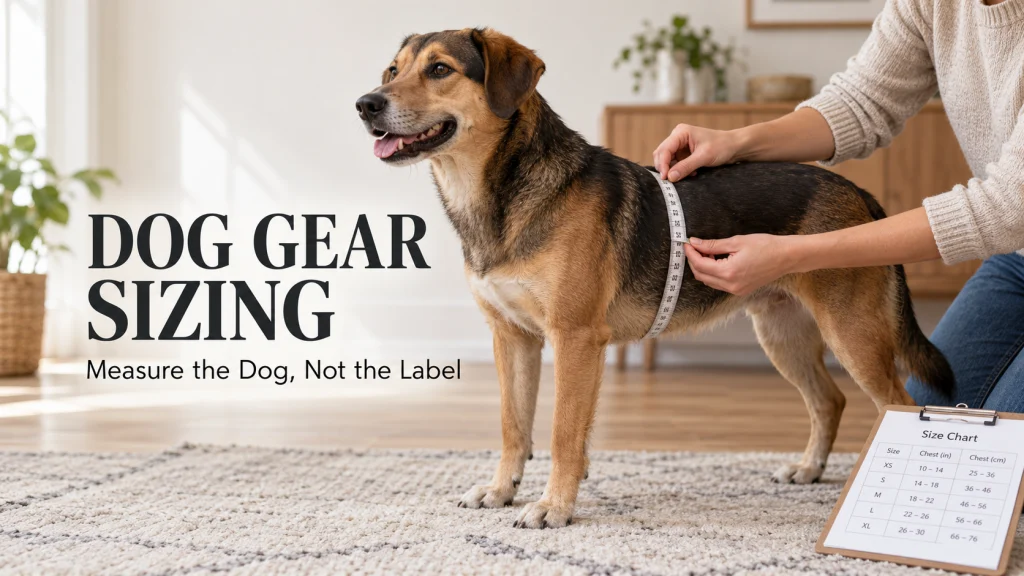
Dog gear sizing works best when the size name is treated as a label and the actual measurements are treated as evidence. A dog can fit one brand’s Medium and miss another because chest girth, body length, standing height, usable interior space, and product geometry matter more than the word on the package. Weight can narrow the field, but it cannot describe body shape or usable space by itself. My approach is to measure the dog, identify the geometry the gear must accommodate, and verify those numbers against the product documentation before choosing a size.
Size labels are names, measurements are evidence
Dog gear sizing becomes confusing when Small, Medium, Large, and Extra Large are treated as measurements. They are names assigned to ranges within a particular product line. A Medium harness can use one chest range while another Medium uses a different range, and similar mismatches appear with carriers, crates, beds, and other gear. I start with the dog’s body and the product dimensions that control fit, then use the label only after those numbers line up.
This approach also removes breed guessing from the center of the decision. Breed can describe a general body pattern, but an individual dog still has its own chest depth, neck size, back length, standing height, and proportions. Two dogs at similar body weights can need different wearable sizes or interior space because their shapes differ. The practical question is not, “What size does this breed usually wear?” but, “Which measured range and usable geometry fit this dog for this job?”
Measure the dog before reading the product’s size name
I would record the measurements that belong to the dog before opening a size chart. For wearable gear, that often means chest girth, neck girth, or body length, depending on what the manufacturer asks for. For enclosed gear, standing height and body length can matter more because the decision is about usable interior room rather than a strap range. Measuring first gives you numbers that stay attached to the dog even when the labels change from one product to another.
The measuring points also need to match the instructions for the product being considered. The American Kennel Club notes that clothing and gear sizing varies by brand and advises checking the measurements listed for the individual product. If a chart asks for chest girth, use the location shown there rather than substituting a collar measurement or a remembered number from another item. When the dog is between ranges or the instructions are unclear, follow the manufacturer’s fit guidance instead of inventing a universal size-up rule.
| Product type | Dog measurements to check | Product measurements to check | What the comparison answers |
|---|---|---|---|
| Wearable gear | Chest girth, neck girth, body length when required | Adjustment range and chart measurement points | Whether the item can fit the dog’s actual body shape |
| Crates and carriers | Standing height, body length, body width when relevant | Usable interior dimensions and opening dimensions | Whether the dog fits inside the space intended for use |
| Beds | Sleeping length and the space the dog normally uses | Usable sleeping surface, not only the outer footprint | Whether the dog has enough actual resting area |
| Ramps | Body size and mobility needs relevant to use | Ramp length, target height, surface, and deployed geometry | Whether the ramp can create a workable path to the target surface |
The table is a starting map, not a universal sizing formula. Keeping the dog’s measurements in a note can make later comparisons faster, but confirm that each product uses the same measuring points before reusing them. A chest number taken for one harness may not answer a different product’s question if its chart defines the location differently. The goal is consistency in what you know about the dog, not blind consistency in how every product interprets those numbers.
Weight limits are not complete fit tests
Weight is useful when a product has a stated capacity or includes weight as one part of its sizing system. What weight cannot tell you is how that mass is distributed across the dog’s body. A compact, broad-chested dog and a taller, narrower dog can weigh about the same while needing very different chest ranges, carrier heights, or crate proportions. Treating weight as the whole fit test replaces geometry with a number that cannot describe it.
This matters most when a product can technically support the dog’s weight but still fail the physical fit. A carrier may list a weight range that includes the dog, yet the dog may be too tall or too long for the usable interior. A ramp may have more than enough capacity, but capacity does not tell you whether its deployed length works with the height of the vehicle or furniture. I use weight as a constraint to verify, then continue to the dimensions and fit instructions that describe the actual space or placement.
- Use weight when the manufacturer treats it as a limit or part of the chart.
- Use body measurements when the product must fit around or contain the dog.
- Use interior measurements when the dog needs usable room inside an enclosure.
- Use placement geometry when the product must connect the dog to a vehicle, floor, bed, or other target surface.
A useful sizing decision therefore has more than one gate. First, the product should not violate a stated weight or capacity limit. Second, the dog’s measurements should fit the relevant size range or usable space. Third, the item still has to work in the household, vehicle, or travel setup where it will actually be used.
Usable interior space can differ from exterior dimensions
Exterior dimensions tell you how much room a crate, carrier, or bed occupies, but they do not automatically tell you how much room the dog can use. Frames, wall thickness, bolsters, sloped panels, door structures, and padding can reduce or reshape the interior. Current crate documentation from Diggs, for example, publishes interior and exterior dimensions separately and tells owners to use interior dimensions for dog fit while using exterior dimensions for room fit. That distinction is simple, but it prevents a common mistake: measuring the available floor space in the home and assuming the same number describes the dog’s interior space.
The same logic applies beyond crates. A soft carrier can flex or narrow around its openings, and a bed with a large outer footprint can have a smaller sleeping surface because raised sides occupy part of that footprint. Instead of comparing one advertised length to the dog’s body length, identify the dimension that corresponds to the space the dog will actually occupy. If you are working through a crate decision, the site’s dog crate size guide takes that product-specific fit question further without turning this article into a universal crate formula.
| Number on the page | What it describes | What it does not prove by itself |
|---|---|---|
| Exterior length | The product’s outside footprint in that direction | How much straight interior length the dog can use |
| Interior length | Usable internal distance as defined by the manufacturer | Whether the dog also has adequate height or width |
| Weight range | A stated weight-based sizing or capacity reference | Whether the dog’s height, length, or body shape fits |
| Size name | A label within that product line | Equivalence to the same label from another product |
When I see only an exterior dimension, I do not fill in a missing interior number by assumption. I look for a dimension drawing, specifications table, manual, support page, or manufacturer answer that defines the usable space. If that information is still missing, the page does not support a precise fit conclusion. Guessing past that boundary creates false confidence, which is exactly what measurement-based sizing is supposed to avoid.
Brand charts do not transfer reliably
A dog product size chart belongs to the product or product line that published it. Even within one brand, a different design can use different adjustment ranges, openings, panel shapes, or measuring points. I do not save “my dog is a Large” as a stable body fact. I save the dog’s measurements so I can compare them with whichever item I am evaluating next.
A familiar label should not overrule a chart that appears surprising. If the dog falls into a different letter size than expected, recheck the measurement and the chart instructions instead of forcing the old label onto the new product. AKC measuring guidance notes that sizing can vary by brand and style, which explains why two items with the same nominal size can fit differently. The published range matters more than continuity with a previous purchase.
Key point: Keep the dog’s measurements as the reusable record. Let each product chart translate those measurements into its own size.
That habit also makes a poor fit easier to diagnose. You can compare the dog’s recorded measurements with the published range and ask whether the mismatch came from measurement, chart interpretation, body proportion, or product geometry. Without those numbers, saying a brand “runs small” or “runs large” may hide the real cause. Measurements give you something concrete to compare when deciding whether to exchange the item or choose a different design.
Fit changes by product job
There is no single measurement that can size every kind of dog gear because different products interact with the dog in different ways. Wearable gear wraps around the body, enclosed gear creates usable volume, beds provide a resting surface, and ramps create a path between two heights. The product’s job determines which dimensions deserve the most attention. I would rather use a small set of relevant measurements than collect every possible number and pretend they all carry equal weight.
The use case can also change what a good fit means within the same broad product category. GUNNER’s current crate guidance, for example, distinguishes travel fit from home kenneling guidance, showing why intended use can change the target geometry even when the dog has not changed. That is not a rule for every crate; it shows why use-specific instructions matter. The same reasoning applies to a carrier used under an airline seat, a bed placed inside a fixed nook, or a ramp deployed to a particular vehicle height.
Wearable gear
Wearable items usually depend on circumference and placement more than on body weight alone. Chest girth, neck girth, or body length may control the decision, but the exact measuring point should come from the product chart. A harness that fits around the chest can still be wrong if another required area falls outside its adjustment range or the panel geometry sits poorly on the dog’s build. Measure the body, read the range, and then check the fit as the manufacturer instructs once the item is on the dog.
Crates and carriers
Crates and carriers need a comparison between the dog’s body and the usable interior, not just the product’s outside footprint. Carrier sizing can also include a stated weight limit, but Sherpa’s current guidance says to choose size from the pet’s measurements followed by weight and to allow enough room for position changes. That ordering keeps capacity and physical fit as separate checks. For a deeper carrier-specific process, use the dog carrier size guide rather than borrowing a crate rule or a wearable chart.
Beds
A bed is often sold by its outer dimensions, yet the sleeping area can be smaller when bolsters or thick edges take up part of the surface. The dog’s usual sleeping posture matters because a curled sleeper and a dog that stretches out use the surface differently. I would compare the dog’s resting length and preferred posture with the usable sleeping area when that information is available. If a listing gives only the footprint, I would not assume every inch of that footprint is available to the dog.
Ramps
Ramp fit is a geometry problem between the ramp and the target height, not simply a question of whether the dog fits on the surface. PetSafe’s support guidance tells owners to measure the vehicle entry point and compare that height with the ramp guidance, and it warns against creating a steep incline for the target height. The site’s dog ramp angle guide handles that placement decision in more detail. The important principle here is that a ramp can satisfy a weight limit and still be a poor fit for the place where it must be deployed.
Use the exact product page and manual
The final check is whether the documentation actually belongs to the product you are evaluating. Product generations can change, similar models can use different dimensions, and retailer summaries can omit details found in manufacturer specifications or support pages. I look for the model name, dimension drawing, fit instructions, and any use-specific limitations before treating a number as reliable. If a safety-sensitive use depends on setup or compatibility, current manufacturer instructions should take priority over a generic sizing article.
This is where verification prevents false precision. The site’s guide to reading dog product manuals and specifications explains how to match claims to the right documentation instead of relying on a retailer summary. Check whether the page distinguishes interior from exterior dimensions, whether weight is a limit or a sizing clue, and whether fit changes with intended use. If the documentation does not answer the fit question, the responsible conclusion is that more information is needed.
Final Thoughts: good sizing starts with the dog and the exact product
I treat dog gear sizing as a measurement problem because measurements can be checked against the job the product has to do. Start with the dog, identify the dimensions that control that job, and verify the corresponding product dimensions or ranges. Use weight when it is relevant, but do not let it substitute for body shape, usable space, or placement geometry. If the numbers conflict with expectations, recheck how the measurement was taken before choosing.
The best sizing process is not the one with the most numbers; it uses the right numbers for the decision in front of you. A harness needs body measurements, an enclosure needs usable interior space, a bed needs usable resting area, and a ramp needs workable placement geometry. Keep the product-specific procedures in the pages that own those decisions, and use this framework as the common starting point across categories. A size name is useful only after the underlying measurements support it.
Frequently asked questions
📏 What measurements should I keep for dog gear sizing?
Keep the measurements your dog’s gear commonly asks for, such as chest girth, neck girth, body length, and standing height. Recheck the measuring points whenever a new product defines them differently.
🐕 Can I choose dog gear by breed?
Breed can be a rough reference, but it should not replace the individual dog’s measurements. Dogs of the same breed can differ in body shape and proportions, and brand charts can define sizes differently.
⚖️ Is my dog’s weight enough to choose a carrier or crate?
No. Weight can be an important limit or sizing clue, but you still need to check body dimensions and usable interior space. A dog can fall within a stated weight range and still be too tall, long, or broad for the intended space.
📦 Why are interior and exterior dimensions both important?
Interior dimensions help you judge the dog’s usable space, while exterior dimensions help you judge whether the product fits the room, vehicle, or storage area. One set of numbers should not be substituted for the other.
🧵 Should I always size up when my dog is between sizes?
No universal size-up rule works across every product. Recheck the measurement, read the manufacturer’s between-size instructions, and consider the adjustment range and intended use before choosing.
🚗 Does a ramp’s weight capacity tell me whether it will fit my setup?
No. Capacity is only one check; deployed length and target height determine the slope and placement geometry. Compare the exact ramp guidance with the surface or vehicle entry point where you plan to use it.
References and Sources
- AKC dog gear measuring guide: Supports measuring the individual dog and checking product-specific sizing because brand and style sizing can vary.
- Diggs crate sizing documentation: Shows separate interior and exterior crate dimensions and directs owners to use interior dimensions for dog fit.
- GUNNER sizing guide: Provides an example of manufacturer-defined interior and exterior dimensions and use-specific fit guidance.
- Sherpa carrier specifications: Supports choosing carrier size from pet measurements first, then checking the stated weight limit and usable room.
- PetSafe ramp fit guidance: Supports checking the target entry height and deployed ramp geometry rather than relying on capacity alone.