Dog gear maintenance belongs in the buying decision because the work does not stop when the product finishes its main task. Cleaning, drying, charging, replacing filters or other parts, and putting everything back together can turn a convenient product into a recurring household routine. The right choice depends on how much upkeep the household will actually do, not on how many features the box lists. A simpler option can be the better fit when it solves the task with less cleaning, storage, charging, or replacement burden.
Count the work after the product finishes its job
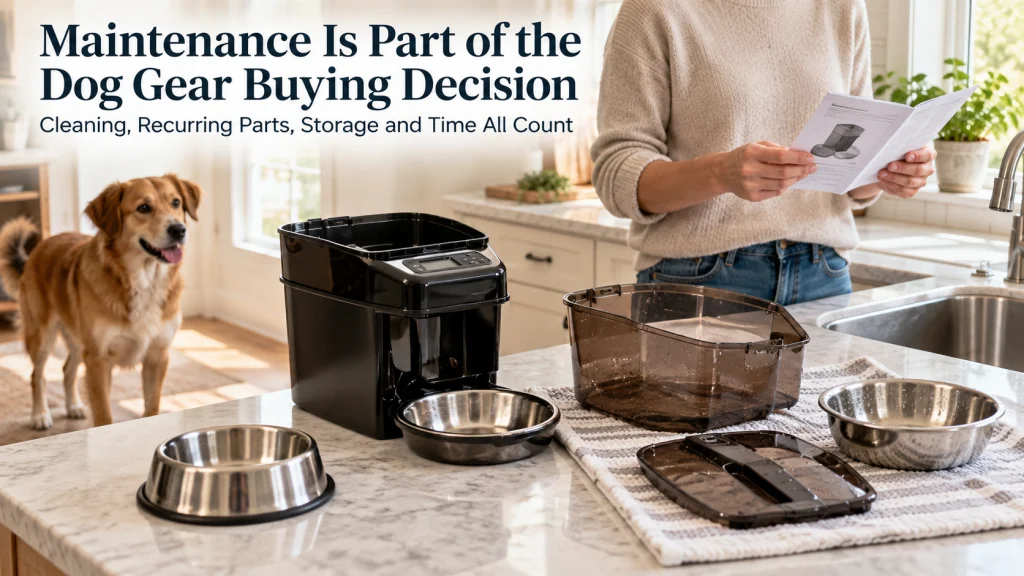
Dog gear maintenance is easy to ignore while comparing features because most of the sales pitch focuses on the moment the product is working. The automatic feeder dispenses food, the robot vacuum collects hair, the water fountain circulates water, and the washable bed gives the dog a place to rest. I would not treat that moment as the whole ownership experience. If the product still has to be emptied, rinsed, dried, charged, filtered, wiped, stored, or reassembled, that work belongs in the decision.
The important question is not whether a product has maintenance, because nearly every piece of gear does. The useful question is whether its maintenance matches the household routine and the dog related mess it will actually face. A home with heavy shedding, muddy paws, frequent travel, limited drying space, or little storage may experience the same product very differently from a home with lighter cleanup demands. That is why I would compare the complete ownership cycle rather than the feature list alone.
| Ownership stage | Typical work to count | Why it matters |
|---|---|---|
| Initial work | Unpack, assemble, measure, place, configure, or charge before first use | This shows the setup burden, but it usually happens once or only occasionally. |
| Recurring work | Empty, wash, dry, recharge, inspect, restock consumables, or reassemble | This is the routine that determines whether the product stays convenient over time. |
The distinction matters because a product with a longer initial setup can still be easier to own than a product that adds small chores every day or every cleaning cycle. I would give recurring work more weight when it is frequent, messy, easy to postpone, or dependent on parts the household must keep buying.
Cleaning time is part of ownership
A product can save effort during use and still create more work later. An automatic feeder may remove one repetitive mealtime step, but its useful maintenance picture includes the food path, bowl, hopper, moving parts, and the parts that cannot simply be submerged. PetSafe’s instructions for the Healthy Pet Simply Feed, for example, separate dishwasher safe components from the conveyor and base, and the cleaning process also includes disassembly, drying, and reassembly. That does not make the feeder a bad choice, but it shows why the cleaning process deserves the same attention as the feeding features.
The same logic applies across dog ownership categories. A removable cover can make a bed easier to live with, but the owner still needs a place and routine for washing and drying it, and the inner materials may have different care limits. A vacuum that handles pet hair automatically still has a bin and filter system that needs attention. Before I call any product easy to maintain, I want the exact care instructions to show what comes apart, what can be washed, what must stay dry, and how much handling is required to return the product to service.
- What must be emptied or wiped after normal use?
- Which parts can be washed, and which parts must stay dry?
- Does cleaning require disassembly or tools?
- Must parts dry completely before the product can be used again?
- Does the cleanup fit the sink, laundry, drying, and storage space available in the home?
These questions turn a vague claim such as easy to clean into something a household can actually evaluate. For product specific cleaning routines, I would follow the exact manual or support page rather than assume that similar looking models are maintained the same way.
Consumables can turn a one time purchase into a recurring cost
The purchase price is only the first number when a product depends on filters, bags, pads, batteries, liners, cartridges, brush heads, or other replaceable items. Some of those parts are routine consumables, while others are replacement parts that may only matter after wear or damage. I would separate the two because they affect ownership differently. A cheap main unit can become expensive to keep running if the required consumables are costly, hard to find, or sold in small packs.
I would not invent an annual maintenance total from a generic category average. The cleaner method is to identify the exact model, check which parts the manufacturer says are replaceable, verify the current part price, and then calculate the cost using the documented replacement guidance and the household’s real usage. If the manufacturer gives no fixed interval, that uncertainty should stay visible rather than being converted into a made up schedule. This keeps the comparison grounded in what the owner can verify instead of turning maintenance into another marketing estimate.
| Recurring item | What to verify | How to estimate ownership cost |
|---|---|---|
| Filter or bag | Exact model compatibility, cleaning limits, replacement guidance, current pack size | Current cost per usable replacement multiplied by the number the documented routine requires |
| Battery | Battery type, whether power is optional or required, and how the product signals low power | Use the household’s actual replacement pattern rather than an assumed universal interval |
| Brush, pad, or liner | Whether it is washable, reusable, replaceable, and available for the exact model | Compare replacement cost with the useful life documented for that exact part when available |
For a worked example, use hypothetical arithmetic rather than pretend the numbers belong to a real product. If a six pack of compatible filters costs $24, each filter costs $4. If the household’s documented or observed replacement pattern uses three filters during the comparison period, the consumable cost is 3 x $4, or $12. If the same household uses all six filters, the cost is $24. The example does not create a replacement schedule; it shows how current compatible part pricing and verified household usage turn recurring maintenance into a number that can be compared before buying.
Drying and reassembly can be the real bottleneck
Washing is often the visible step, but drying can decide whether maintenance feels easy or annoying. PetSafe instructs owners to make sure cleaned feeder parts are completely dry before reassembly, and iRobot similarly requires a rinsed bin to be dry before the filter goes back in. Those details matter in a small kitchen, apartment, laundry area, or busy household where parts may occupy a counter or rack while they dry. A product that cleans quickly can still be inconvenient if it cannot return to use until several components are dry and correctly fitted.
Reassembly is another hidden part of the routine. If the owner must align a conveyor, latch a hopper, reinstall a filter, reseat a brush, or check that a cover is fully closed, the process has more failure points than wiping one solid surface. I would look for care instructions that make those steps clear and repeatable. The point is not to avoid every product that comes apart, but to make sure the household is willing to repeat the process as often as the product will realistically need it.
Replacement parts matter before something breaks
Replacement support is part of maintainability even when nothing has failed yet. Filters, rollers, side brushes, lids, bowls, covers, power adapters, and other model specific pieces can determine whether a product stays useful after normal wear or a minor accident. I would check the manufacturer’s support and parts information before treating a replaceable component as an advantage. A replaceable part only helps if the exact part is identifiable, compatible with the model, and realistically obtainable.
This is also where similar looking products can diverge. Two devices may perform the same household task, but one may have clearly documented parts while the other provides little information beyond the original package. That difference does not automatically decide the purchase, but it changes the risk of owning the product over time. When replacement support is unclear, I would count that uncertainty as part of the decision rather than assume a generic part will fit.
Storage and charging belong in the routine
Some maintenance happens even when the product is not dirty. Cordless tools, powered cleaning gear, travel devices, and other electronics may need a charging location, cable access, and a place where the dog cannot interfere with the setup. Large attachments, spare filters, bowls, covers, and cleaning tools also need somewhere to live between uses. A product that is convenient on the floor can become inconvenient if every use starts with finding parts and ends with clearing storage space.
I would therefore evaluate the home, not just the product. Check where the item will charge, where damp or dirty parts can sit, whether accessories stay together, and whether the stored footprint is acceptable. If a device saves a few minutes but creates a permanent cable, dock, accessory bin, or drying zone in a cramped room, that trade off should be visible before purchase. For homes where space is the harder constraint, a manual or simpler option may fit better even when it offers fewer features.
Self cleaning does not mean no maintenance
Words such as automatic, self emptying, washable, and easy care describe a feature, not the entire maintenance system. A robot vacuum may empty debris into a base, but the robot still has filters, brushes, sensors, a bin, and other surfaces that need attention according to the exact model instructions. A washable dog bed cover can reduce the difficulty of dealing with hair or dirt, but the owner still has to remove, wash, dry, and reinstall it. Orvis, for example, describes a removable machine washable cover and a water resistant liner protecting the foam on its Memory Foam Couch Dog Bed, which is useful precisely because the care boundaries are defined.
I would read these claims as a starting point for questions rather than as proof that ownership is effortless. What does the automatic feature actually automate, and what remains manual? Which pieces still collect hair, food residue, moisture, or dirt? When the claim is narrowed to the exact task it handles, it becomes easier to decide whether the product reduces meaningful work in that particular household.
The household’s willingness to maintain the product is a fit variable
Maintenance fit is partly about the dog and partly about the people living with the gear. A heavy shedding dog may fill filters and brush areas faster than a light shedding dog. A dog that tracks in wet soil can make covers, mats, floors, and cleaning tools work harder, while a dog with a neater indoor routine may create less frequent cleanup. The right maintenance burden therefore depends on coat, activity, home surfaces, weather exposure, feeding setup, and how the product is actually used.
The human side matters just as much. Some households are comfortable washing removable parts and keeping spare consumables on hand, while others need gear that can be wiped, stored, and forgotten until the next use. Neither routine is morally better, but pretending they are the same produces bad recommendations. I would rather choose a product whose care routine will actually happen than choose a more capable product whose maintenance will be postponed until performance suffers.
| Maintenance burden check | What to ask before buying |
|---|---|
| Cleaning | Can the dirty parts be reached and cleaned with the sink, laundry, or tools already available? |
| Drying | Is there a realistic place for washed parts or covers to dry fully? |
| Reassembly | Will the owner reliably put the product back together correctly after cleaning? |
| Consumables | Are required filters, bags, pads, batteries, or other parts easy to identify and obtain? |
| Storage and charging | Is there a practical place for the product, cable, dock, attachments, and spare parts? |
| Dog related mess | Does the dog’s coat, activity, feeding style, or outdoor routine increase the cleanup burden? |
The worksheet is useful because it forces the recommendation to meet the household that will own the product. It also makes it easier to compare a feature rich option with a simpler one without assuming that more automation always means less work.
When the simpler product wins
The simpler product wins when it solves the real task with less recurring work and no important loss of fit, safety, or function. A basic bowl may fit a feeding routine better than a powered feeder if nobody needs scheduled dispensing. A straightforward washable surface may fit better than a layered system if the extra layers add drying and reassembly without solving a household problem. A manual cleaning tool may be more practical than powered equipment when storage, charging, and replacement parts create more friction than the task itself.
This is why I would connect maintenance back to the original job before comparing features. If the task is already solved by gear the household owns, buying another system can create a second maintenance routine without removing the first one. The broader decision framework in when not to buy dog gear applies here: maintenance is one more reason to ask whether the purchase removes a real constraint. More capability is useful only when the household will maintain the capability it is paying for.
For category specific decisions, the same logic should move into the exact routine. A washable dog bed needs care instructions that match the cover and inner materials, a dog water fountain needs a cleaning routine that matches its pump and filter system, and cleaning an automatic dog feeder depends on the exact food path and removable parts. When floor cleanup is the task, a wet dry vacuum for pet messes should be judged partly by the cleanup required after it handles the mess.
Final Thoughts: maintenance is a feature even when the box does not list it
I would treat maintenance as part of product fit, not as an afterthought that begins once the return window is over. The useful comparison includes what gets dirty, what must be replaced, what has to dry, what needs charging, what takes storage space, and what must be put back together correctly. Those steps can change whether a product actually saves time in the household. They can also explain why a simpler item sometimes produces the better ownership experience.
Before buying, check the exact manual or support page and map the care routine onto the home and dog in front of you. If the maintenance is clear, manageable, and worth the task the product solves, the extra complexity may be justified. If the upkeep is likely to be skipped, the product is a weaker fit no matter how impressive the feature list looks. Maintenance is not separate from value because the household has to keep doing it long after the purchase is finished.
FAQs
🧼 How do I know whether dog gear is actually easy to clean?
Check the exact care instructions, not the marketing phrase. Look for what comes apart, what can be washed, what must stay dry, whether tools are needed, and whether parts must dry fully before reuse.
🔋 Should batteries and charging count as maintenance?
Yes, when the product depends on power. The charging location, cable, battery type, replacement availability, and the household’s habit of keeping the product ready all affect how convenient it is to own.
🧽 Does washable mean the whole product can go in the washing machine or sink?
No. Washable claims often apply to specific covers, bins, bowls, or other removable parts, while filters, foam, motors, bases, or electronics may have different care limits. Follow the instructions for the exact model and each component.
💰 How should I compare recurring maintenance costs?
Identify the exact consumables or replacement parts first, then check current compatible part pricing and the manufacturer’s replacement guidance. If no fixed interval is documented, use your actual replacement pattern instead of inventing one.
🏠 When is a simpler product the better choice?
A simpler option is often better when it solves the same household task without creating extra cleaning, charging, storage, or replacement work. The answer changes when added features solve a real constraint that the simpler option cannot handle.
References and Sources
- PetSafe Healthy Pet Simply Feed cleaning instructions: supports the examples about disassembly, cleaning different components, complete drying, and reassembly.
- iRobot j series bin and filter care: supports the distinction between rinsing the bin, keeping the filter dry, and allowing the bin to dry completely before reassembly.
- Orvis Memory Foam Couch Dog Bed: supports the example of a removable machine washable cover and a water resistant liner protecting the foam.