
Knowing when not to buy dog gear is part of making a good ownership decision, not a rejection of useful products. I would stop shopping when the household already has a workable tool, when an upgrade adds features without solving a new problem, or when the real issue belongs to training, routine, veterinary care, or another kind of support. I would still buy gear when it solves a defined safety, access, or workload problem that the current setup does not handle well. The useful question is not whether a product looks better, but whether it owns the problem you are trying to solve.
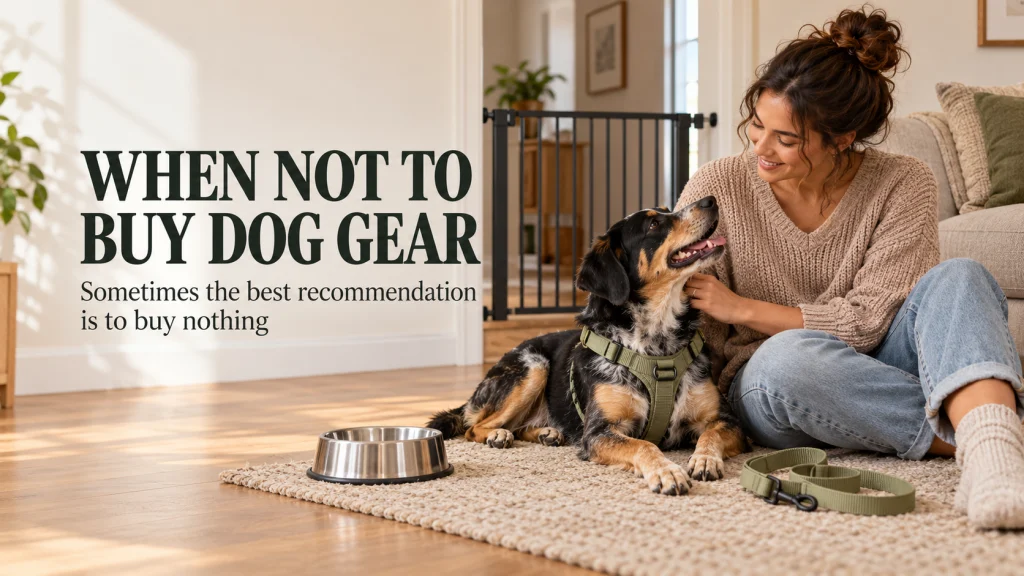
Start by defining the problem before deciding it needs a product
Sometimes the best product comparison ends before the shopping starts. If I cannot describe the actual problem in one plain sentence, I am not ready to compare features, materials, sizes, or prices. A dog owner may think the problem is “I need a better product” when the real issue is inconsistent routine, poor fit, missing training, a household setup problem, or a change in the dog’s condition. Buying first can make that distinction harder because the new item creates another thing to set up, clean, store, monitor, or replace.
I start with the job, the dog, and the household constraint. Is the goal to prevent access to a room, keep meals on a consistent schedule, remove an odor source, make a slippery route easier to use, or reduce a daily chore that is genuinely difficult to maintain? Then I ask whether the household already has something that can do that job safely and reasonably well. If the answer is yes, the burden of proof shifts to the new purchase: it should solve a specific limitation, not merely look more specialized.
| Decision point | If yes | If no |
|---|---|---|
| Can you state the actual problem in one plain sentence? | Move to the next question. | Stop shopping and define the problem first. |
| Does the current setup already solve that problem safely and reasonably well? | Skip the purchase unless a specific limitation matters in daily use. | Move to the next question. |
| Does the problem need training, veterinary input, or required safety equipment before a convenience purchase? | Handle that need first, then reassess whether gear still has a job. | Move to the final question. |
| Will the new product solve a clear fit, access, safety, workload, or maintenance constraint? | Compare options that solve that defined job. | Skip the purchase for now. |
Read the table from top to bottom. A “no” can end the shopping process early, while a “yes” may simply move the decision to the next question. Buying is reasonable when the product reaches a defined job that the current setup does not solve. If the path never reaches that point, doing nothing for now can be the more useful recommendation.
Skip the purchase when the household already owns a workable tool
A dog product does not become inadequate just because a newer version exists. If a gate still blocks the intended doorway, a bowl is easy to clean and suits the dog’s eating setup, or a storage container keeps supplies organized as intended, replacing it may not improve the dog’s care at all. I would first look for an actual failure such as poor fit, difficult cleaning, instability, damaged material, unreliable operation, or a new household constraint. Without one of those reasons, the current tool may already be doing the whole job.
This matters because every replacement carries its own ownership burden. A different shape may use more floor space, a more complex mechanism may need more cleaning, and a specialized accessory may only work with one system. Even when the purchase price is comfortable, the new item can add friction to a routine that was previously simple. A plain tool that is already safe, functional, and easy to live with can be more valuable than a feature-rich replacement that solves no new problem.
- Keep the current item if it still fits the dog and the task.
- Replace it when wear, damage, poor fit, or a changed routine creates a real limitation.
- Upgrade only when the added function will be used often enough to matter.
- Do not treat novelty by itself as evidence that the current setup is deficient.
The practical test is simple: name what becomes easier, safer, more reliable, or more manageable after the purchase. If that answer is vague, I would keep using what already works. If the answer is concrete and tied to daily life, then the purchase has a clearer reason to exist.
Skip a feature upgrade when the existing product solves the job
Feature lists are good at making a working product feel unfinished. Extra settings, app controls, additional compartments, premium materials, or a larger capacity can sound useful even when they do not change the task the dog owner actually needs to complete. I would separate features that remove a recurring constraint from features that simply create more ways to interact with the product. The first group can justify an upgrade, while the second may only add setup and maintenance.
Frequency matters here. A feature that saves effort every day can have real value, especially for a household with a difficult schedule, limited storage flexibility, or a repetitive care task. A feature used twice and forgotten is harder to defend, even if it looked impressive on the product page. The question is not whether the feature is good in isolation, but whether it earns its place in this household’s routine.
| Upgrade reason | What would justify it | Reason to skip |
|---|---|---|
| More automation | It reliably removes a recurring scheduling burden. | The owner still has to do the same checks and manual work. |
| More capacity | The current size creates frequent refilling or storage problems. | The larger size adds bulk without reducing meaningful work. |
| More settings | The dog or routine genuinely needs that control. | The extra controls do not change the result. |
| Premium construction | Durability, cleaning, or fit is a known problem with the current item. | The current item remains sound and easy to maintain. |
A higher price can still be worth paying when it removes a real source of friction. What I would not do is assume that more features automatically mean more value. The upgrade has to solve something the current product cannot solve well enough.
Do not buy another cleaner before finding the odor source
Repeated odor is a good example of a product problem that may not be a product problem at all. If the source is still present in fabric, flooring, bedding, a crate area, a hidden accident spot, or another part of the home, changing bottles may only change the smell for a short time. I would first identify where the odor is coming from, what material is holding it, and whether the area can actually be cleaned according to the material and cleaner instructions. That work tells you whether a new cleaning product is necessary or whether the current process simply has not reached the source.
The same logic applies when the dog is repeatedly bringing dirt, moisture, or odor back into the same space. A stronger cleaner does not change the entry route, drying routine, washable surfaces, or bedding schedule that may be recreating the problem. For a broader look at separating odor source, cleaning routine, and home setup, the guide to managing dog smell in the house belongs earlier in the decision than another impulse purchase. Once the source and surface are understood, it becomes much easier to decide whether the household needs a different cleaner at all.
Key point: A cleaner should be chosen for the actual surface, soil, and label directions after the source is identified. Do not use a stronger or different product as a substitute for figuring out what keeps recreating the odor.
That distinction also keeps the article within an owner-level cleaning decision. It does not require guessing at hidden health causes or making claims about what a smell means medically. The practical job is to locate the source, clean the right material correctly, and reassess before adding another product to the shelf.
Do not buy a behavior gadget to replace training or management
A device can change what happens in a moment without teaching the dog what to do instead. If barking, jumping, counter surfing, door rushing, chewing, or another recurring behavior is the problem, I would first look at triggers, access, reinforcement, routine, and what replacement behavior is being taught. Management can reduce opportunities for the unwanted behavior while training builds a more useful response. A gadget is not automatically useless, but it should not be allowed to hide the fact that the dog still needs a clear, humane learning plan.
I am especially cautious when a product works by startling, intimidating, or causing discomfort. The American Veterinary Society of Animal Behavior recommends reward-based training and advises against aversive training methods, so I would not treat an aversive device as an easy substitute for teaching and management. Dog owners dealing with a recurring problem can start with the site’s guide to everyday dog behavior problems and then decide whether any equipment has a supporting role. If the behavior is severe, sudden, dangerous, or beyond ordinary owner-level training, the next step is appropriate professional help rather than another gadget.
When to hand the decision off: If the behavior involves a serious safety risk, sudden major change, or a problem the household cannot manage safely, stop treating shopping as the main solution. The useful next step is qualified behavioral or veterinary guidance appropriate to the situation.
The important distinction is between equipment that supports a plan and equipment that is expected to replace the plan. A barrier, leash, treat pouch, or other simple tool can be useful because it helps the owner manage access or deliver reinforcement. It still works inside a training and management process, not instead of one.
Do not buy automation to replace necessary human care
Automation is useful when it handles a repetitive task without removing the checks that still matter. A timed feeder, for example, may help a household deliver food on a more consistent schedule, but it does not observe the dog, notice a change in appetite, refill itself, clean its food-contact parts, or decide whether the setup still fits the dog’s needs. I would buy automation to solve a scheduling or workload constraint, not to create the illusion that the care task has disappeared. The owner still needs a routine for checking the dog and the equipment.
This is why the value of an automated product depends heavily on the household. Someone with an irregular work schedule may get real benefit from a device that performs one narrow task at a predictable time, while someone who is already present for every meal may gain very little. The site’s guide to choosing an automatic dog feeder is useful when meal timing is the actual problem, not when the goal is to remove human oversight. Automation can reduce labor, but it should not erase the owner’s responsibility to notice whether the dog, food, water, and equipment are functioning normally.
For me, the purchase makes sense when the automated task is clearly defined and the remaining human checks are still realistic. If the device only moves work around or creates more maintenance than it removes, I would keep the simpler routine. Convenience should reduce a real burden, not just make the setup look more advanced.
Do not buy a mobility product when the limitation needs veterinary input first
A ramp, step, support harness, mat, or raised setup can be useful when the task and limitation are already understood. The mistake is assuming that a new hesitation, limp, weakness, change in rising, or other mobility difference is simply a shopping problem. Older dogs can have mobility changes for many reasons, and owner observation cannot identify the cause with certainty. I would document what changed, where it happens, and how consistently it happens, then involve a veterinarian when the change is new, worsening, significant, or otherwise concerning.
AAHA’s senior care guidance treats mobility and musculoskeletal changes as information worth evaluating rather than something to dismiss as normal aging. That does not mean every slower movement requires a complicated intervention, and it does not mean mobility products are inappropriate. It means the product decision should follow the dog’s actual limitation instead of guessing at the cause from one visible sign. The broader guide to caring for an older dog is the better place to frame home changes around the dog’s overall condition and daily function.
When to hand the decision off: If movement has changed in a way that is new, worsening, painful, or difficult to explain, get veterinary input before treating a mobility purchase as the answer. A product can modify the environment, but it cannot diagnose why the dog is moving differently.
Once the limitation is clearer, simple changes may be enough. Better traction may solve a surface problem, a lower access point may reduce an unnecessary step, or a properly chosen aid may make a repeated task easier. The point is not to delay useful support; it is to avoid buying the wrong kind of support for a problem that has not been defined.
Buy safety equipment when the use case genuinely requires it
Purchase restraint has a limit: I would not use “buy nothing” as a reason to skip equipment that controls a real safety risk. A dog that needs secure containment, a barrier from a hazardous area, appropriate restraint for a specific travel setup, or another safety function may genuinely need equipment because the task cannot be handled safely by wishful thinking. In those cases, the question changes from “Can I avoid buying this?” to “What exact function, fit, and setup does this safety item need to provide?” That is still a restrained buying decision because the purchase is tied to a defined use case.
Safety products also deserve more verification than ordinary convenience items. Fit, dimensions, compatible anchor points, weight or size limits, materials, instructions, and the exact environment can change whether an item is suitable. I would follow current manufacturer instructions and any appropriate authoritative guidance rather than assuming that a familiar product category is automatically safe in every setup. Buying the right thing carefully is different from buying more things.
There is no contradiction between recommending fewer purchases and recommending necessary safety equipment. The same rule applies in both directions: identify the problem first, then choose the minimum setup that actually solves it. Sometimes that answer is “use what you already have,” and sometimes it is “this job needs purpose-built equipment.”
Convenience can still be worth paying for
Not every purchase needs to solve a crisis. Reducing a boring, repetitive, physically awkward, or easy to forget task can be a legitimate reason to buy something, especially when that improvement helps the household maintain a better routine. I would not shame an owner for paying to save time or effort when the product fits the dog, the budget, and the actual workflow. Convenience becomes weak value only when the promised benefit is mostly imaginary or the product adds as much work as it removes.
The useful comparison is total burden before and after the purchase. Include setup, cleaning, storage, charging or power, consumables, replacement parts, learning the controls, and the chance that the product requires its own new routine. Then compare that burden with the time, consistency, access, or physical effort it saves. A convenience purchase earns its place when the net result is meaningfully better for the household without creating a new problem for the dog.
| Reason to buy | What to verify | Reason to skip |
|---|---|---|
| Saves repeated daily effort | The saved work happens often enough to matter. | The task is already easy and brief. |
| Improves routine consistency | The product supports the routine without hiding important checks. | The same consistency can be achieved with a simpler setup. |
| Improves access or handling | The dog and household can use it comfortably and correctly. | The product creates storage, fit, or setup problems. |
| Reduces cleanup or maintenance | The maintenance instructions are actually simpler in practice. | The product adds parts, consumables, or cleaning steps. |
I see convenience as a valid ownership benefit, not a guilty pleasure. The standard is simply higher than “this looks easier” because the hidden workload matters too. If the household will use the benefit regularly and the tradeoffs are acceptable, paying for convenience can be a sound decision.
Final Thoughts: not buying is a recommendation when the product does not own the problem
I do not think good dog gear advice should end with a product every time. Sometimes the best answer is to keep the tool that already works, fix the routine, locate the source of the problem, train the behavior, or ask a veterinarian to evaluate a change before buying an aid. That is not anti-product and it is not a claim that cheaper is always better. It is simply a way to make sure the recommendation matches the problem.
When a product does own the problem, I want the reason to be easy to explain: it improves safety, fit, access, consistency, workload, or another real part of daily care. When it does not, I would rather stop the comparison than invent a reason to keep shopping. The goal is not to own less dog gear at any cost; it is to own what earns its place in the dog’s routine and the household that has to live with it. That is the standard I use before recommending anything new.
FAQs
The questions below are the ones I would use to test a purchase before treating a new product as the obvious next step. They are intentionally practical because the same item can be useful in one household and unnecessary in another. Start with the problem, then check what the current setup already does. Only after that does it make sense to compare products.
None of these answers is a rule against buying useful gear. Safety needs, mobility changes, behavior concerns, and household constraints can all change the decision. The point is to avoid turning every inconvenience into a shopping problem. A clear reason to buy is more useful than a long list of features.
🐾 How do I know if I actually need new dog gear?
Name the job the current setup fails to do. If you can identify a real problem with safety, fit, access, reliability, cleaning, workload, or routine, a new purchase may be justified. If the current setup already handles the job well, keep it until a specific limitation appears.
🧰 Is it worth upgrading dog gear just for more features?
Only if those features solve a recurring problem you actually have. Compare the added benefit with setup, cleaning, storage, maintenance, and replacement burden. More controls or capacity are not automatically more useful.
🧼 Should I buy a stronger cleaner if dog odor keeps coming back?
Find the odor source and identify the affected material first. A different cleaner may be appropriate for a specific surface or soil, but changing products will not help much if the source remains. Follow the cleaner label and the care instructions for the surface.
🎓 Can a behavior device replace dog training?
It should not replace a humane training and management plan. Equipment can support access control, handling, or reinforcement, but the dog still needs clear cues, appropriate management, and a learnable alternative behavior. Severe or unsafe behavior needs qualified help rather than a shopping shortcut.
🍽️ Is an automatic feeder unnecessary if I am usually home?
Possibly. If your current meal routine is consistent and easy to maintain, automation may add little value. It becomes more useful when timing or workload is a real constraint and you can still perform the necessary checks and cleaning.
🐕 Should I buy a ramp as soon as my older dog slows down?
Do not assume a new mobility change is only an equipment problem. Observe what changed and discuss new, worsening, painful, or significant movement changes with a veterinarian. Once the limitation is clearer, you can choose home changes or mobility aids that match the actual task.
References and Sources
These sources support the two evidence boundaries that go beyond ordinary buying judgment. AVSAB supports the training section. AAHA supports the mobility section. I kept the list narrow so every source has a job.
The rest of the article is editorial judgment about matching a purchase to a defined ownership problem. It does not depend on brand comparisons or product performance claims. Exact product decisions should follow current instructions and specifications. Medical or advanced behavior questions belong with the appropriate professional.
- American Veterinary Society of Animal Behavior position statements: Supports the article’s boundary around reward-based training and avoiding aversive training tools as a shortcut for behavior work.
- American Animal Hospital Association senior pet care recommendations: Supports involving a veterinarian when an older dog’s mobility or activity changes rather than assuming the issue is only a gear problem.