
Dog product manuals often contain the conditions that a marketing page compresses into a feature claim. I use manuals, support pages, care instructions, and model-specific documentation to check what a product actually requires before treating a benefit as meaningful. That extra step can reveal cleaning limits, power behavior, replacement needs, compatibility boundaries, or setup conditions that change whether a product fits a household. The goal is not to make ownership more complicated, but to separate what the product can do from what it needs you to do.
The manual is where the conditions usually live
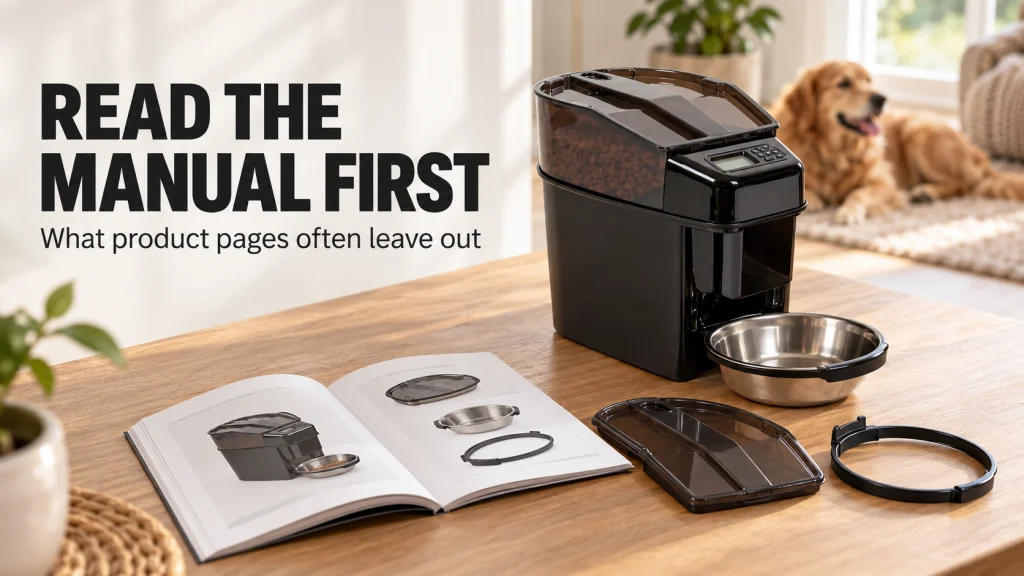
I usually reach for the manual when a feature sounds useful but the ownership routine is still unclear. If a feeder promises scheduled meals, I want to know how the food path comes apart for cleaning, what happens after a power interruption, and which settings the owner has to restore or check. If a bed is described as washable, I want to know whether that means the cover, the liner, the foam, or some combination of those parts. Those details turn a broad benefit into a household decision instead of a slogan.
The same check helps me avoid treating one convenient word as if it described the whole product. A removable part can have different care instructions from the powered base, and one model can have different controls or accessories from another model in the same family. I match the exact product or clearly identified variant first, then look for the operating condition that would change cleaning, setup, compatibility, maintenance, or daily workload. That gives the rest of the review a concrete question to answer instead of repeating the feature claim in longer form.
Marketing pages describe benefits, manuals describe operation
A quick way to use documentation is to turn each attractive feature into a verification question. If the page says programmable, check what programming actually requires and what interrupts it; if it says washable, check exactly which parts can be washed; if it says automatic, check what still needs cleaning, charging, emptying, replacing, or resetting. This is not a hunt for contradictions. It is a way to translate a benefit into the operating work a dog owner will actually have to manage.
PetSafe’s support library for the Healthy Pet Simply Feed is a good example of that separation. The main support page provides the manual and also breaks out cleaning, programming, pausing, priming, and troubleshooting into separate instructions, which makes the operational burden much easier to see. That does not make the feeder good or bad by itself, and I am not treating the documentation as a recommendation. It simply shows why a reader comparing automatic dog feeder setup and ownership should look beyond the product headline before deciding what will be easy to live with.
| What you are checking | Marketing page usually emphasizes | Documentation often clarifies |
|---|---|---|
| Cleaning | Easy care or washable parts | Which parts detach, which parts must stay dry, and how to reassemble them |
| Power and controls | App control, automation, or battery operation | Setup steps, behavior after power loss, charging conditions, and control limitations |
| Consumables | Convenience or low-maintenance use | Which filters, bags, liners, or other parts need attention or replacement |
| Compatibility | Broad use case | Model, accessory, surface, size, or configuration limits |
The useful question is therefore not whether one page is more trustworthy in every situation. It is whether the source you are reading was designed to answer the decision you are making. A feature claim can tell you what to investigate, while the documentation tells you what to verify before relying on it. That distinction keeps a simple product comparison from turning into an assumption.
Cleaning restrictions can change a recommendation
Cleaning language is one of the easiest places to overgeneralize. “Washable” can describe a removable cover, a bowl, a hopper, a rubber toy, or an entire assembly, and those are not interchangeable instructions. PetSafe’s documentation for its feeder, for example, distinguishes between parts that can be washed and the powered base that should not simply be treated like a kitchen container. The practical issue is not whether cleaning is possible, but how much disassembly, drying, reassembly, and care the routine actually requires.
The same problem shows up with dog toys. KONG’s own FAQ says care can differ by material and product construction, including different handling for rubber toys and fabric toys, so a generic “dishwasher safe” shortcut is not enough for every item. That is why I would use the exact care instructions first and then use a broader dog toy cleaning routine to organize the job around the products actually in the home. The manual or care page supplies the limit, while the household routine supplies the workable method.
Battery and offline behavior often live in support documentation
Connected products can look simple on a sales page because phrases such as app control, smart scheduling, or automatic operation describe the intended experience. They do not always explain what happens when the device loses power, loses network access, needs to recharge, or cannot reach its dock. iRobot’s support library for the j7 family separates owner guides, setup material, and model-specific support, which is exactly the kind of documentation trail I want before making a claim about how the system behaves. Its j7 setup guidance also documents that recharge and resume behavior depends on the robot being able to reach its base and on how the cleaning job was started. A household decision changes when an apparently automatic feature depends on a condition the owner has to maintain.
This matters for dog homes because automation is often chosen to reduce repetitive work, not create another device that needs constant attention. If a robot vacuum is part of a dog-hair cleanup routine, the useful question is not just whether it can navigate or run on a schedule, but what its support material says about charging, docking, connectivity, maintenance, and recoverable errors. Those checks belong beside practical questions about floors, shedding, obstacles, and cleaning frequency in a robot vacuum decision for dog hair. Support documentation helps define the failure conditions before convenience is treated as a reliable household benefit.
Replacement intervals and consumables affect ownership
A purchase price is only one part of ownership when a product depends on bags, filters, liners, batteries, cartridges, or other replaceable parts. Product pages may mention those items, but support documentation often does a better job of showing when they matter and what happens when they are missing, full, worn, or installed incorrectly. iRobot’s Clean Base support, for example, explains bag replacement and related maintenance rather than leaving the bag as a small accessory footnote. That information turns a feature such as automatic dirt disposal into a clearer picture of the recurring work behind it.
I do not assume that a consumable makes a product a poor choice. The right question is whether the recurring input solves enough of the owner’s workload to justify its cost, storage, replacement routine, and availability. A simpler product with fewer replaceable parts may be the better fit for one household, while another household may value automation enough to accept the extra maintenance. The documentation lets that trade-off be evaluated before the replacement burden becomes a surprise.
Setup warnings matter when a product interacts with vehicles, electricity, or moving parts
The more a product depends on placement, power, movement, or another system, the less useful a generic feature description becomes. A ramp has to fit the dog and the access point, a powered feeder has to be assembled and cleaned without treating its electronics like washable parts, and a moving robot has to operate around the actual layout of the home. Documentation can identify the conditions the manufacturer expects the user to control. Those conditions should be checked before I turn a feature into practical advice.
For a vehicle accessory, that means the exact setup matters more than a broad label such as portable or heavy duty. A dog ramp decision, for example, depends on the dog’s size and mobility, the vehicle opening, the usable length, the surface, and the way the product is secured or positioned, which is why those checks belong in a dedicated dog ramp setup guide rather than being improvised from a product photo. The same principle applies to powered equipment: follow the exact manual for electrical, moving-part, assembly, and maintenance requirements. Documentation does not replace judgment, but it tells you which conditions are not optional.
A missing manual is a research limitation
If I cannot find a current manual, care page, support article, or other first-party instruction for a product-specific claim, I treat that as a limit on what I can say. It is not proof that the product is unsafe, poorly made, or unsupported. It simply means I cannot verify a condition that may matter to the recommendation. The correct response is to narrow the claim, look for another first-party source, or leave the point unresolved rather than filling the gap with an assumption.
This is also where model numbers and exact variants matter. A support page for a related product may look close enough, but a small difference in power system, material, accessory, control layout, or cleaning method can make the instruction wrong for the item being discussed. I use a short documentation check before relying on a product-specific detail, and the checklist is deliberately boring because boring checks prevent confident mistakes. If one of the essential pieces is missing, that uncertainty belongs in the decision.
- Match the exact product name, model, or clearly identified variant.
- Prefer the manufacturer manual, support page, care instructions, label, or official compatibility information.
- Check whether the instruction applies to the whole product or only to one removable part, accessory, or mode.
- Separate a documented limit from an inference based on a photo, retailer summary, or similar model.
- Stop at the evidence boundary when the documentation does not answer the question.
This checklist does not make every purchase decision technical. Most of the time it simply confirms whether a convenient feature has a manageable condition attached to it. The point is to know when the easy summary is enough and when the exact instruction changes the answer. That final check is often what separates a documented condition from a convenient guess.
Retailer summaries are not a substitute for first-party documentation
Retailer pages are useful for current variants, package contents, availability, and the questions buyers are actually asking. They are weaker as the only source for model-specific care, safety, compatibility, or operating limits because summaries can compress, omit, or standardize details across a listing. A retailer answer may point me toward the right question, but I still want the manufacturer documentation when the claim depends on an exact product. That source matching is more important than collecting a large number of links.
Orvis provides a useful contrast on its Memory Foam Couch Dog Bed page because the product page itself includes specific care information about the removable machine-washable cover and water-resistant liner. In that case, the first-party product page contains a care condition that is directly relevant, so I do not need to pretend a separate manual is always superior. The rule is simpler: use the first-party document that actually supports the claim, and do not upgrade a short retailer summary into evidence it was never designed to provide. Good documentation research is about matching the source to the question, not worshiping a particular file format.
Final Thoughts: read the conditions before judging the feature
The product page tells me what deserves attention, but the documentation tells me what I have to verify. I would not reject a product because its manual contains restrictions, since clear restrictions can be a sign that the operating conditions are actually documented. What matters is whether those conditions fit the dog, the household, the maintenance routine, and the amount of work the owner is willing to accept. A feature becomes useful only when the requirement attached to it is workable.
That is why I read the boring document before I trust the exciting claim. Check the exact model, identify the condition behind the benefit, and decide whether the cleaning, setup, power, compatibility, or replacement burden fits the real use case. If the documentation cannot support a product-specific statement, narrow the statement instead of guessing. That habit keeps a recommendation grounded in what the product is documented to do rather than what a short sales summary makes easy to assume.
FAQs
📘 Should I always read the full manual before buying dog gear?
Not always. Start with the sections that affect your decision, such as cleaning, fit, compatibility, power, setup, replacement parts, warnings, and maintenance, then read deeper if those sections raise a question.
🧼 Can I trust a product page that says something is washable?
Use that claim as a prompt to check the exact care instructions. “Washable” may apply only to a removable cover, bowl, hopper, or toy material, while other components may need a different method.
🔌 Why do support pages matter for powered dog products?
Support pages often explain setup, power behavior, charging, controls, errors, and maintenance in more detail than a shopping page. Those conditions can change how dependable or convenient the product is in your household.
🧩 What should I do if I cannot find the exact manual?
Do not substitute instructions from a similar model unless the manufacturer clearly says they apply. Narrow the claim, look for official support or care documentation, and treat any remaining gap as unverified.
🛒 Are retailer listings useful for product research?
Yes, especially for current variants, package details, availability, and recurring buyer questions. For exact care, safety, compatibility, or operating limits, verify the point against first-party documentation when that documentation exists.
References and Sources
- PetSafe Healthy Pet Simply Feed support: Provides the product manual plus model-specific cleaning, programming, setup, and troubleshooting documentation.
- KONG FAQ: Documents care differences across toy materials and directs owners to check product-specific cleaning instructions.
- iRobot j7 series owner guides: Provides model-specific owner guides and related documentation for the j7 family.
- iRobot j7 setup guide: Documents Wi-Fi setup and the conditions around recharge and resume behavior.
- iRobot Clean Base care chart: Documents recurring care and replacement tasks associated with the automatic dirt disposal system.
- Orvis Memory Foam Couch Dog Bed care details: Documents the removable machine-washable cover and water-resistant liner on the exact product page used as an example.