Dog owner reviews are useful when they reveal questions that product pages and polished marketing copy do not answer. My method is to treat reviews as community evidence, separate fit and preference from factual product claims, and then verify recurring complaints against documentation or stronger evidence before repeating them as facts. A detailed complaint can be more useful than a high star average, but repeated anecdotes still do not become a measured failure rate. The goal is to use owner feedback as a map for what to investigate next, not as a substitute for verification.

I use reviews to find questions, not manufacture facts
How I use dog owner reviews starts with a simple distinction: an owner can report a real experience without proving that the same outcome is common, typical, or caused by the product itself. If several people describe a buckle that slips, a harness that rotates, a feeder that is awkward to clean, or a crate tray that is difficult to remove, I treat those reports as leads. I want to know what part of the product, setup, dog, or routine might explain the pattern. I do not turn the number of comments I found into a percentage or pretend an unstructured review section is a survey.
This matters because owner feedback is collected under messy conditions. Dogs differ in body shape, coat, activity, handling, and behavior, while households differ in floors, vehicles, storage, cleaning routines, and expectations. A complaint can be entirely valid for one setup and irrelevant to another. I therefore separate the reviewer’s observation from the conclusion I might be tempted to draw from it.
| Evidence level | What I use it for | What it does not prove |
|---|---|---|
| Single owner report | Identify a possible use problem, fit issue, maintenance burden, or failure mode | Frequency, typical performance, or universal outcome |
| Recurring owner reports | Prioritize a question for verification and look for shared conditions | A measured defect rate or statistical prevalence |
| Manufacturer manual or specification | Verify stated dimensions, adjustment method, cleaning instructions, compatibility, or intended use | How every dog and household will experience the product |
| Strong independent evidence | Support a broader performance or safety conclusion when the method and conditions match the claim | Claims beyond the tested conditions |
That evidence ladder keeps the review useful without asking it to do work it cannot do. The review tells me where to look, then the next source determines how far the conclusion can go.
Star averages hide the shape of the problem
A star average compresses many different experiences into one number. A low score might reflect shipping damage, confusing assembly, poor fit for a particular body shape, a seller problem, or a genuine product defect. A high score can also hide a recurring irritation that does not bother most owners enough to change their rating. I learn more by reading for the reason behind the rating than by treating the average as a performance score.
I also look at the source and context of the review rather than assuming every rating deserves equal weight. The Federal Trade Commission advises consumers to consider where reviews come from, look at reviewer history and timing, and avoid assuming that a review can be authenticated just by how it looks. Incentives and material connections can also affect the weight a review deserves. That makes the written detail, the reviewer’s conditions, and the possibility of outside influence more useful than the headline number alone.
- What exactly happened during use?
- What dog size, body shape, coat, activity, or behavior context is described?
- Was the complaint about the product, the seller, shipping, setup, or expectations?
- Does the reviewer describe a repeatable condition that can be checked elsewhere?
- Is there any disclosed incentive or relationship that should change how much weight the review receives?
Those questions do not make a review true or false. They help me decide whether the review contains a useful observation, a weak signal, or a claim that needs much stronger verification.
Detailed negative reviews can expose a failure mode worth checking
A detailed negative review can be valuable because it often describes the moment when a product stopped fitting the owner’s routine. Someone may explain that an adjustment slider moved during walks, a removable liner was harder to reinstall than expected, or a latch was difficult to operate with one hand. Those details give me a mechanism to investigate instead of a vague statement that the product is bad. The useful part is the described failure mode, not the anger attached to it.
I then ask whether the condition can be independently checked. If a complaint says a part cannot be removed for cleaning, the manual may show whether removal is intended and how it should work. If several owners describe the same adjustment problem, I look for the exact strap layout, adjustment points, and fitting instructions before deciding whether the product design plausibly explains the complaint. This is also where I separate a recurring inconvenience from a safety conclusion, because the latter needs stronger support than owner frustration.
Key point: A specific complaint can reveal what to verify next, but specificity is not the same as proof.
That distinction keeps a vivid story from gaining more evidentiary weight simply because it is memorable. One precise account can be a very good question generator and still remain one account.
Repeated anecdotes are still anecdotes
When the same complaint appears again and again, I take it more seriously as a research lead, but I do not convert repetition into a failure rate. Review platforms do not give me a controlled sample of all buyers, all dogs, or all use conditions. People who had an unusually good or bad experience may be more motivated to post, and the visible review pool may also be shaped by platform rules, moderation, incentives, or listing changes. Without a documented study design, I cannot claim that a certain share of owners will have the same result.
The better use of repetition is to look for conditions shared across the reports. A fit complaint that mostly appears around deep chested dogs means something different from a complaint that appears across many body shapes and sizes. A cleaning complaint from owners using the product every day may matter more to a high workload household than to someone using it occasionally. Context turns a pile of anecdotes into a sharper question without pretending it is statistics.
| What the reviews suggest | What I check next | What I can safely say before verification |
|---|---|---|
| Several owners say an adjustment slips | Manual, strap routing, adjustment hardware, use instructions, and any stronger independent evidence | Owners have reported adjustment movement under some conditions |
| Several owners say one size fits the chest but not the neck | Official measurement ranges and the dog body shapes described in the reports | Fit may vary by proportions, not only by weight label |
| Several owners say cleaning is awkward | Disassembly instructions, washable parts, drying steps, and household workflow | Maintenance may be more cumbersome for some routines |
The language stays deliberately narrow until the stronger source arrives. That protects the reader from a confident conclusion that the available evidence has not earned.
I check the manual after a recurring complaint appears
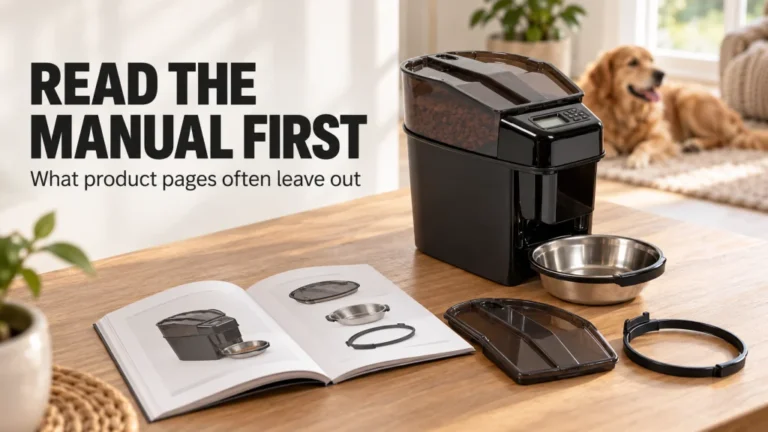
Once a complaint is specific enough to investigate, I move away from the review section and toward documentation. A manufacturer manual can confirm how a buckle is meant to route, whether a panel is removable, what measurements define a size, which parts are washable, or whether an accessory is actually compatible. That is why I use dog product manuals as a verification source instead of asking owner comments to settle a specification question. Reviews can tell me where confusion happens, while the manual tells me what the product is officially designed to do.
My recurring complaint check is straightforward. I write the complaint as a testable question, identify the exact product or feature being discussed, check first party documentation, and then look for stronger independent evidence if the claim is about performance rather than a stated specification. If the documentation does not support the complaint, I do not automatically dismiss the owner; I look for a difference in version, setup, size, or use condition. If the evidence remains unclear, I keep the conclusion narrow instead of filling the gap with confidence.
- Turn the complaint into a specific question.
- Confirm the exact product, version, size, or feature when possible.
- Check the relevant manual, specification, support page, or official instruction.
- Use stronger independent evidence when the claim concerns performance or safety.
- Record the remaining uncertainty instead of guessing.
This workflow is slower than copying the most repeated comment, but it produces a much cleaner distinction between community experience and verified information. That distinction is the part I want the reader to carry forward.
I treat size and fit complaints differently from product defects
Fit complaints deserve special handling because the same product can behave differently on dogs with different proportions. Two dogs can have similar weight and still need different neck, chest, back length, or adjustment ranges. A review that says a harness was too loose around the neck but tight around the chest may be describing a real mismatch without proving that the item was manufactured incorrectly. For that reason, I compare the complaint with the official measurement range and the dog’s body shape before calling it a defect.
This is also why I separate size labels from actual measurements. Medium, large, and similar labels are only useful when the underlying ranges match the dog being fitted. My broader approach to checking dog gear sizing is to start with the measurements the product actually uses and then look at how the item sits on the individual dog. Reviews become most useful when they include that kind of context rather than only the label on the package.
| Owner statement | What it is | What verification adds |
|---|---|---|
| “The medium was tight at the chest and loose at the neck.” | An anecdote about fit on one dog | Official neck and chest ranges show whether that body shape falls awkwardly within the size design |
| “The manual lists separate neck and chest adjustment ranges.” | A verifiable specification | The specification can be checked directly against the manufacturer documentation |
| “This product is badly sized for all dogs.” | A broad conclusion not supported by one review | It would require much stronger evidence across relevant sizes and body shapes |
Separating those categories prevents a fit mismatch from becoming a universal defect claim. It also gives the owner a more useful next step, which is to compare measurements and proportions rather than chase a different star average.
Community reports are useful for maintenance and workflow friction
Reviews are especially useful for revealing ownership burden that may be hard to see in a product description. Owners often mention whether a cover is annoying to reinstall, whether hair collects in a seam, whether a bowl base traps water, or whether a piece of gear takes more storage space than expected. Those reports do not need to become universal performance claims to be helpful. They can expose the small recurring tasks that determine whether a product fits a household routine.
I read those comments with the household condition in mind. A cleaning issue that matters in a small apartment with a heavy shedding dog may be less important in another home, while storage or drying time may be the deciding burden somewhere else. When the question expands beyond one product into routine cleanup, I route the reader toward practical guidance on keeping a home clean with dogs rather than pretending a product review can solve the whole task. The review is useful because it reveals friction, not because it automatically identifies the best solution.
That same logic applies to owner reports about setup time, repeated readjustment, or parts that are easy to misplace. These are often the details that determine whether someone keeps using a product after the initial purchase. I treat them as workload evidence that deserves context and verification, especially when the burden depends on frequency of use. The result is a recommendation that reflects daily ownership rather than only features on a listing.
I do not turn Reddit into veterinary, nutrition, or behavior authority
Community discussions can be excellent at showing what dog owners are confused about, what questions recur, and which situations deserve a clearer explanation. They are not a substitute for veterinary, nutrition, behavior science, or other appropriate professional evidence when the claim crosses into those areas. A thread about a dog refusing food, suddenly changing behavior, or reacting badly to equipment may contain useful observations, but the comments do not establish a diagnosis or treatment. My boundary is to use the community report to identify the question, then move to the source type that actually owns the answer.
That means a behavior discussion may lead the reader toward owner level guidance on training a dog, while feeding setup questions may belong with practical guidance on feeding a dog. If the issue becomes medical, clinical nutrition, or advanced behavior treatment, I stop treating peer comments as evidence for what the owner should do. The same boundary is explained more broadly in my approach to dog care advice and evidence limits. Community evidence is strongest when it helps define the real owner question without pretending to answer beyond its competence.
Warning: A recurring health or behavior story can show that owners are encountering the same concern, but repetition does not turn peer advice into diagnosis, treatment, or professional guidance.
Keeping that line visible is part of using owner feedback responsibly. It lets the community contribute real world questions while leaving factual and safety sensitive conclusions to evidence that can actually support them.
Final Thoughts: community evidence is a map to the next question
Owner reviews are most useful when I read them as observations with conditions attached. A recurring complaint can tell me what deserves attention, a detailed negative review can reveal a plausible failure mode, and maintenance comments can expose routine burdens that specifications rarely make obvious. None of those signals gives me permission to invent a failure rate or call an anecdote a universal fact. The next step is always to ask what source can verify the part of the claim that matters.
That approach also makes product research more useful for dog owners. Instead of asking whether the crowd loved or hated something, I can ask whether the reported issue applies to this dog, this household, this setup, and this task. When documentation confirms a specification, I can state it as a specification; when only owner reports exist, I keep the wording at the level those reports support. Community evidence points me toward the next question, and verification decides how confidently I can answer it.
FAQs
Review research gets easier when each type of information has a clear job. Ratings can help surface products worth investigating, written reviews can reveal conditions and frustrations, and documentation can settle factual specification questions. The questions below focus on the points that most often cause owner feedback to be given too much or too little weight. The same rule applies throughout: match the strength of the conclusion to the strength of the evidence.
I also avoid making authenticity judgments from one clue alone. A strange review may be genuine, and a polished review may still be misleading or influenced. The practical goal is not to identify every fake review with certainty. It is to decide how much weight a review deserves and what should be checked elsewhere before it affects a recommendation.
⭐ Should I trust a product because it has a high star rating?
No. A high average can hide different reasons behind the ratings, so read for specific conditions, recurring issues, and whether important claims can be verified elsewhere.
🔎 Does seeing the same complaint many times prove there is a defect?
No. Repetition makes a complaint worth investigating, but it does not establish a defect rate or prove the cause without stronger evidence.
📏 How should I read reviews about dog gear sizing?
Look for actual measurements and body shape, not only the size label. A fit problem on one dog may reflect proportions rather than a manufacturing defect.
🧼 Are maintenance complaints useful?
Yes, especially when they describe a specific cleaning, storage, drying, or setup burden. Compare the complaint with the manual and with the workload of your own household.
🧾 When should I check the product manual?
Check it when a review makes a factual claim about dimensions, adjustment, cleaning, assembly, compatibility, or intended use. The manual is the better source for what the product is officially designed to do.
🐾 Can Reddit or owner forums answer health or behavior questions?
They can show what owners are experiencing and what questions recur, but they should not be used as veterinary or advanced behavior authority. Move to the appropriate professional or evidence source when the issue crosses that boundary.
References and Sources
These sources support the evidence handling rules used in this article. They are included because review authenticity, incentives, and the weight given to consumer feedback are factual topics where primary guidance is useful. The article does not use them to convert owner anecdotes into product performance statistics. They support the boundary between review observations and stronger verification.
I use the consumer guidance for practical checks such as source, timing, reviewer history, and the limits of visually judging authenticity. I use the business guidance for the treatment of incentives, material connections, fake reviews, and misleading review practices. Together they explain why review context matters before an owner comment is repeated as evidence. Product specific claims still require product specific documentation or stronger evidence.
- FTC consumer guidance on evaluating online reviews: Supports checking review sources, timing, reviewer history, incentives, and other context before relying on a review.
- FTC guidance on endorsements, influencers, and reviews: Supports the distinction between honest consumer feedback and review practices that can be misleading, incentivized, or otherwise require additional context.