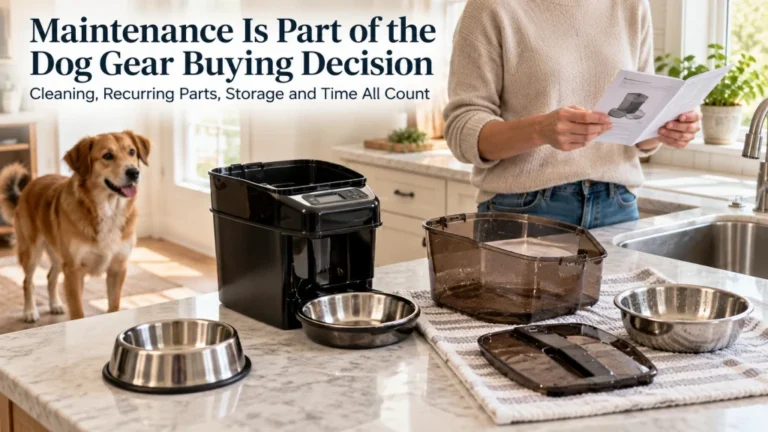
Dog gear value is not the same thing as low price, premium materials, or a long feature list. I judge value by whether a product solves a real household problem well enough to justify its purchase cost, recurring cost, maintenance, storage, and setup burden. Sometimes that points to a more expensive product, sometimes to a basic tool, and sometimes to buying nothing at all. The useful comparison is not cheap versus premium; it is problem solved versus burden accepted.
Value starts with the problem being solved
Dog gear value makes sense only after the job is clear. A household trying to keep meals on schedule has a different problem from one trying to make a doorway safer, protect a floor, or help an older dog reach a vehicle. I start with the dog, the routine, and the physical setup, then ask what keeps failing or creating extra work. Price becomes meaningful only after that problem is defined.
A useful value check is simple: identify the problem, identify the conditions that make it difficult, and then count the burdens introduced by the proposed solution. Those burdens can include cleaning, charging, storage, replacement parts, app setup, manual adjustments, or simply having another object in the house. A product earns its place when the improvement is large enough to justify those costs for that specific household. That is why the same item can be sensible for one owner and unnecessary for another.
Value equation: useful problem solved divided by total burden accepted. The practical improvement sits on one side of the comparison, while purchase price, recurring fees, maintenance, setup, storage, compatibility, replacement effort, and owner time sit on the other. A higher price can still represent better value when it solves a recurring problem much more effectively without adding disproportionate burden. A low price can represent poor value when the product saves little and creates new work.
- What recurring problem is this supposed to solve?
- How often does that problem actually happen?
- What setup, cleaning, storage, or replacement work comes with the solution?
- Would a simpler change solve the same problem with less burden?
- What happens if the product is not used exactly as intended?
This framework also keeps product decisions connected to the rest of the home. A crate, gate, feeder, bed, or access aid should work with the dog’s size and behavior as well as the space around it, which is why I treat setting up a home for a dog as part of the value decision rather than a separate decorating question. A product that creates a new traffic problem, cleaning problem, or storage problem can be poor value even when it performs its narrow task. Solving one issue while quietly creating two more is not much of a bargain.
Replaceable parts can matter more than luxury materials
Material descriptions often dominate product marketing because they are easy to photograph and easy to summarize. Repairability is less glamorous, but it can change what happens when one small component wears, breaks, or gets lost. A product with a replaceable motor, dispenser, bowl, latch, cover, or other service part may give an owner more options than a product that must be discarded as a complete unit. That does not guarantee durability, but it changes the consequence of a failure.
I separate those ideas deliberately. A replaceable part is evidence that a repair path exists; it is not evidence that the product will last longer or fail less often. Likewise, a premium material may be useful for cleaning, weight, weather exposure, or fit, but it is not automatically a better value if the product cannot be maintained for the owner’s actual use. The decision should follow the likely failure points and the household’s willingness to perform basic maintenance.
This is where documentation earns more trust than adjectives. If a manufacturer publishes part listings, installation instructions, compatibility details, and support paths, an owner can at least see what service is possible before buying. If those details are absent, I treat the unknown as an unknown rather than filling it with optimism. Value improves when the owner can make a realistic plan for what happens after something stops working.
A simple tool can beat a smart product
Complexity should have to earn its keep. If a basic bowl, washable mat, physical gate, manual measuring tool, or other simple item solves the problem reliably, adding electronics or extra mechanisms may only add maintenance. The better value is the option that handles the task with the least burden that still meets the dog’s needs. Simple does not mean cheap, and smart does not mean useful.
The same reasoning applies to access equipment. When an owner is choosing a dog ramp, a high feature count matters less than whether the dimensions, surface, slope, storage needs, and dog fit work in the actual location. An elaborate design that is too awkward to deploy may be used less often than a simpler one that fits the vehicle and routine. Use frequency is part of value because a product cannot solve a recurring problem from the back of a closet.
| Comparison | What I would value more |
|---|---|
| Many features versus one repeated need | The option that reliably solves the repeated need |
| Premium finish versus easier cleaning | The surface and design the household can maintain |
| Smart control versus simple manual use | The method that fits the actual routine |
| More accessories versus easier storage | The setup that can stay accessible and ready to use |
The table is not a rule that simple products always win. It is a reminder to compare the feature with the household problem rather than with another marketing checklist. If the advanced function removes a repeated burden, it may justify added cost and complexity. If it does not, the simpler tool has the stronger value case.
Time and maintenance are part of cost
Owners pay for gear with more than money. Some products need washing, charging, refilling, calibration, software setup, inspection, seasonal storage, or routine replacement of small parts. None of those tasks is automatically unreasonable, but they belong in the comparison because they compete with the owner’s time and attention. A product that saves five minutes in one place while creating fifteen minutes of maintenance somewhere else may not improve the routine.
I therefore look at dog gear maintenance before treating convenience as a benefit. The important questions are how often the item needs attention, what can be cleaned normally, what needs special handling, and what happens when maintenance is skipped. Manufacturer instructions matter here because powered products and exact components may have specific cleaning or service limits. If the maintenance routine feels unrealistic before purchase, it will not become easier simply because the product is expensive.
Time can also favor the more expensive option when the benefit is concrete. A reliable mechanism that repeatedly removes an awkward daily step may be worth paying for in a household where that step causes genuine scheduling problems. I still want the owner to count the new tasks the device introduces before calling it a win. Good value reduces the total burden, not just the most visible burden.
A warranty is not proof of durability
A warranty tells me something about coverage terms, not how long a product will actually last in a particular home. Those are different questions, and blending them creates false confidence. Whisker lists a one-year warranty with the Feeder-Robot and offers an extension to three years for $50, with separate terms describing covered issues and the claim process. That is useful ownership information, but it does not establish a three-year lifespan or prove that one feeder is more durable than another.
When I read warranty language, I look for what is covered, what is excluded, when coverage begins, who handles shipping, and whether the exact product or part is included. I also check whether support requires registration, proof of purchase, cleaning, return shipping, or another condition that changes the practical value of the policy. A generous-sounding duration can still be inconvenient if the process does not match the owner’s expectations. The warranty is part of the burden and risk calculation, not a quality score.
This distinction protects both expensive and inexpensive products from lazy conclusions. A low-priced item without long coverage is not automatically disposable, and a premium item with extended coverage is not automatically durable. If independent lifespan evidence is not available, I stop at what the warranty actually proves. That boundary is more useful than pretending a policy document can predict years of household use.
The best value can be not buying anything
Some shopping problems are really setup problems, routine problems, or fit problems wearing a product-shaped costume. If a gate is inconvenient because it is installed in the wrong place, a new gate may not solve the issue. If a feeding routine is inconsistent because nobody has agreed on who feeds the dog, a smarter device may only automate the confusion. Before buying, I want to know whether the problem can be fixed by moving, cleaning, measuring, scheduling, or using existing gear differently.
That is why I keep a separate decision point for when not to buy dog gear. No purchase is a legitimate outcome when the current equipment already fits, the problem is rare, the proposed upgrade adds more work than it removes, or the owner has not identified the cause of the frustration. Skipping a purchase is not anti-product thinking; it means choosing for fit. Money saved on an unnecessary upgrade is only part of the benefit because the household also avoids added storage and maintenance.
I also use this check when a product seems exciting before the problem is clear. If the strongest reason to buy is that the feature sounds convenient, I would wait until I can name the recurring task it improves. A useful product should survive that pause. If the need disappears when the marketing language is removed, the value case was probably weak.
Affiliate economics should not change the fit decision
Affiliate revenue creates a material connection, so readers deserve to know when a purchase can generate a commission. FTC guidance says affiliate relationships should be disclosed clearly and conspicuously so readers can judge the recommendation with that connection in mind. Disclosure solves the transparency problem, but it does not solve the editorial problem by itself. The recommendation still has to be based on fit, task, evidence, and burden rather than the size of a possible commission.
My standard for affiliate dog product recommendations is therefore the same value framework used everywhere else on the site. A higher-priced option should earn its place by solving a constraint that matters, not by creating more revenue. A cheaper option should win when it handles the task with less burden, and no product should win when buying adds nothing useful. The reader’s dog and household stay at the center of the decision.
This matters because price can quietly distort comparison language. Words such as premium, upgrade, or worth it can sound like conclusions when they are really invitations to ask another question. Worth it for whom, under what routine, and in exchange for what maintenance or cost? If those conditions are missing, the recommendation is not finished.
Final Thoughts: value is problem solved per burden accepted
I think about value as a balance between the problem solved and the burden accepted to solve it. Purchase price belongs in that balance, but so do replacement parts, maintenance, storage, setup, compatibility, and the likelihood that the household will actually use the feature being purchased. Higher price can be reasonable when it removes a recurring problem with manageable upkeep. Lower price can be better when the task is simple and the added features would sit unused.
Before buying, define the problem in one sentence and then test the product against that sentence. Verify the exact specifications, maintenance instructions, warranty terms, and replacement options that matter to the use case, then compare them with a simpler alternative and with doing nothing. If the product still removes more burden than it creates, the value case is strong. If it only looks impressive while adding work, it is probably solving the wrong problem.
Frequently asked questions
💵 Is expensive dog gear worth it?
It can be when the higher price solves a recurring problem that cheaper options do not solve as well for your dog and household. Check the exact feature, maintenance burden, replacement path, and fit instead of treating price as a quality score. If the added capability will rarely be used, the premium may have little practical value.
🧰 Do replaceable parts make dog gear a better value?
They can improve the repair options available after a component fails, but they do not prove the product is durable. Verify that the exact parts are available for the exact model and check whether installation or warranty conditions apply. Treat repairability as one value factor, not as a lifespan guarantee.
📱 Are smart dog products better value than simple ones?
Only when the smart functions solve a real routine problem that you will use often enough to justify the added setup and maintenance. A simple product can be the better value when it performs the same job reliably with less work. Compare the task first and the feature list second.
🧾 Does a longer warranty mean a product will last longer?
No. A warranty describes coverage terms and a claim process, not the product’s expected lifespan in your home. Read what is covered and what you must do to use the warranty, then keep durability claims separate unless there is evidence that supports them.
🏠 How do I know whether I should buy new dog gear at all?
Start by naming the problem and checking whether a change in placement, cleaning, measurement, scheduling, or use of existing gear fixes it. If the problem remains frequent and the new item solves it without adding unreasonable burden, a purchase may make sense. If the need is vague or rare, waiting is often the stronger value decision.
References and Sources
- FTC endorsements, influencers, and reviews guidance: Supports the requirement to disclose material connections clearly when recommendations can generate compensation.
- Furbo Nanny plans: Supports the yearly subscription and renewal pricing used to distinguish recurring service cost from a one-time hardware purchase.
- Whisker Feeder-Robot product page: Supports the listed feeder price, included warranty information, and product ownership details used as a cost example.
- Whisker Feeder-Robot motor assembly: Supports the current replacement motor listing and its warranty guidance.
- Whisker Feeder-Robot dispenser: Supports the current replacement dispenser listing and its warranty guidance.
- Whisker Feeder-Robot hopper insert: Supports the current replacement hopper insert listing and its role as an optional component.
- WhiskerCare for Feeder-Robot: Supports the published extended warranty price, duration, and coverage conditions discussed in the article.